How to Read a DLD Oqood Certificate
Understanding how to read a DLD Oqood Certificate is essential for anyone investing in Dubai real estate, especially in off-plan projects. Issued by the Dubai Land Department (DLD), the Oqood Certificate acts as an official record of your provisional ownership before the final title deed is issued. With Dubai’s real estate sector growing rapidly driven by projects in Downtown Dubai, Business Bay, and Dubai Creek Harbour the Oqood Certificate has become a key part of property transactions.
What Is a DLD Oqood Certificate and Why Is It Important?
The DLD Oqood Certificate is an essential legal document issued by the Dubai Land Department (DLD) to confirm the provisional ownership of an off-plan property. In Arabic, “Oqood” translates to “contracts,” reflecting the system’s purpose of ensuring secure, transparent, and traceable transactions between property buyers and developers before the completion of a project.
Key role of the DLD Oqood certificate in real estate in Dubai
In recent years, the Oqood system has seen increased usage, with over 18,000 new Oqood contracts registered in 2023 alone, reflecting the sustained investor confidence in Dubai’s off-plan properties. This regulatory framework has been a key factor in maintaining market stability amid rapid urban development and global economic uncertainties.
With Dubai’s off-plan market accounting for more than half of total real estate transactions in 2023, the Oqood system has become indispensable for investor confidence. It bridges the gap between initial booking and final title deed issuance, ensuring every transaction is government-regulated and protected.
This certificate plays a critical role in Dubai’s booming real estate market because it:
- Legally safeguards the buyer’s ownership rights for the property under construction.
- Prevents fraudulent sales or disputes, which have historically been a concern in fast-growing property markets.
- Acts as an official record of the sale, registered with the DLD, creating transparency between all parties.
- Allows buyers to resell or obtain financing using the Oqood as proof of ownership before the project is complete.
When Do You Receive the Oqood Certificate?
During an off-plan property purchase in Dubai, the Oqood certificate is typically issued after the buyer signs the Sales and Purchase Agreement and pays the required registration fees. The developer submits all relevant documents to the Dubai Land Department through the Oqood system for processing.
The certificate is generally issued within a few weeks, but delays may occur due to incomplete paperwork, pending payments, or system backlogs. Developers are responsible for ensuring timely submission and accuracy of all buyer details and payment records. Any discrepancies or delays on their part can extend the issuance timeline, affecting the buyer’s official registration process.
How to Read a DLD Oqood Certificate
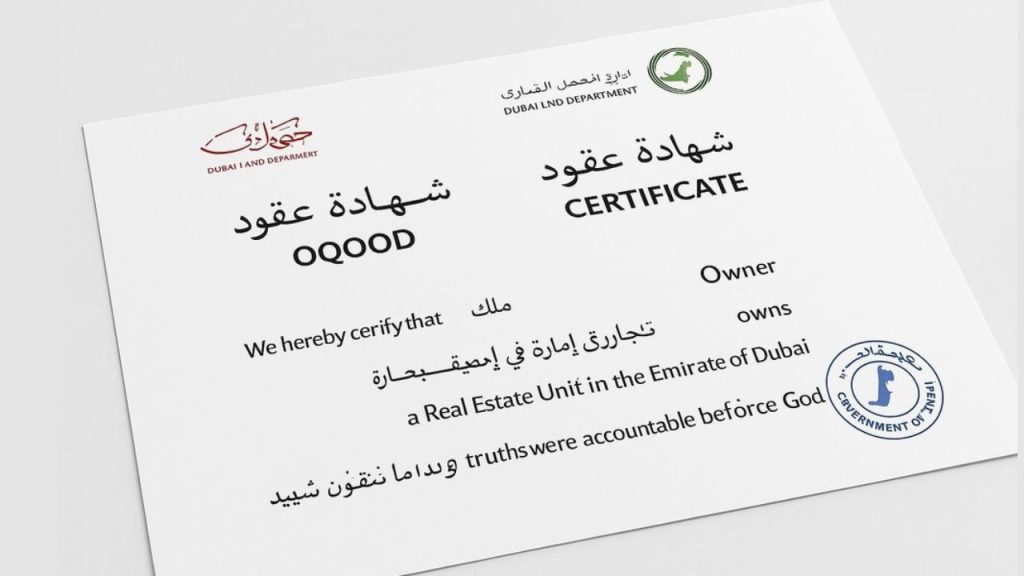
Understanding a DLD Oqood Certificate is essential for anyone investing in off-plan properties in Dubai. Issued by the Dubai Land Department (DLD), this document confirms property registration, payment status, and ownership under the Oqood system. Each section of the certificate provides vital insights that help buyers verify authenticity, compliance, and financial standing.
Property Owner Information
This section confirms the identity of the purchaser and establishes the legal ownership record connected to the Oqood Certificate. It usually includes the buyer’s full legal name, nationality, passport number or Emirates ID details, and sometimes registered contact information such as email address or phone number. These details must exactly match the documents used during the purchase process. Any error in spelling, identification numbers, or ownership percentage can create delays in future transactions, mortgage approvals, resale, inheritance matters, or title deed issuance. Buyers should carefully review this section to ensure the ownership record is accurate and fully protected.
Developer Information
The developer information section identifies the company responsible for constructing and delivering the real estate project. It generally includes the developer’s legal company name, license details, official Dubai Land Department registration number, and sometimes contact information. This section helps buyers verify that the project is being handled by an authorized and properly registered developer operating under Dubai’s property regulations.
Confirming these details is important for transparency, trust, and compliance. It also allows investors to review the developer’s reputation, delivery history, and track record before making future investment decisions or raising project-related concerns.
Project Details
This section provides a complete overview of the registered real estate development linked to the Oqood Certificate. It normally includes the official project name, geographic location, developer name, and Dubai Land Department (DLD) project registration number. Buyers can use this information to verify that the development is legally approved and officially recognized by the relevant authorities.
It may also contain Real Estate Regulatory Agency (RERA) project references, confirming that the project follows Dubai’s regulatory framework for off-plan properties. This is important because RERA oversight helps protect investor funds, construction progress, and compliance standards throughout the development process.
Property Unit Details
The property unit details section explains the exact specifications of the purchased unit within the project. It generally includes the unit number, floor level, building or tower name, plot number, and unit type such as apartment, villa, or townhouse. In many cases, it also states the built-up area in square feet or square meters, which allows buyers to confirm the unit size matches what was agreed in the Sales and Purchase Agreement. This section is essential because it clearly identifies the buyer’s asset and helps prevent confusion between similar units within large developments.
Payment Information
This is one of the most important sections of an Oqood Certificate because it outlines the buyer’s financial obligations and payment progress. It usually displays the total purchase price, agreed installment plan, amounts already paid, due dates for future installments, and any outstanding balance remaining. Some certificates may also reference milestone-based construction payments linked to project progress.
Buyers should review this section carefully to ensure all completed payments are accurately recorded. It helps track compliance with the Sales and Purchase Agreement and provides a clear snapshot of the remaining commitments before handover.
Registration Information
The registration information section contains the official identifiers proving the off-plan property has been recorded with Dubai Land Department systems. It typically includes the Oqood registration number, registration date, and details of fees paid during the registration process. It may also list related DLD or RERA reference numbers for administrative verification.
This section is important because it serves as legal evidence that the buyer’s interest in the property has been formally registered. Keeping these details accurate and accessible is useful for future resale, mortgage applications, or ownership transfers.
Contract Details
This section refers to the Sales and Purchase Agreement (SPA) connected to the unit purchase. It often includes the SPA reference number, contract status, execution date, and other major milestones tied to the transaction. Important dates such as contract signing, Oqood issuance, estimated completion, and handover timelines may also appear.
Reviewing this information helps buyers understand their legal position and track whether the developer is progressing according to the agreed schedule. It is also useful when discussing delays, amendments, or future ownership transfer procedures with the developer or authorities.
Financial Information on the Oqood
One of the most critical parts of the certificate is the financial section, as it reflects all payments, pending dues, and applicable fees. Oqood involves mandatory registration costs for off-plan property purchases in Dubai. The main expense is the Dubai Land Department (DLD) registration fee of 4% of the property value, usually paid at the time of signing the Sales and Purchase Agreement. In addition, there are small fixed administrative and knowledge fees. These charges are paid once and are not paid again when the Oqood is later converted into a final title deed after project completion.
Purchase Price and Payment Breakdown
The Oqood Certificate is an official registration document issued by the Dubai Land Department for off-plan properties in Dubai. It confirms the buyer’s ownership rights during the construction phase and serves as an important legal record until the final title deed is issued. Understanding the purchase price and payment breakdown linked to an Oqood Certificate is essential for investors purchasing off-plan real estate, as it helps track financial obligations and verify payment status throughout the project lifecycle. Buyers should compare this information with their Sales and Purchase Agreement to ensure consistency and avoid future disputes.
The certificate outlines:
- Total purchase price of the unit.
- Amount paid by the buyer to date.
- Remaining balance and payment schedule (for off-plan units).
Note: The DLD typically charges a registration fee (4% of property value) to record ownership.
Service Charges and Hidden Costs
Some Oqood Certificates or related project documents may indicate estimated service charges or maintenance fees applicable to the community. These charges are important because they affect the long-term cost of ownership and overall rental yield. While figures shown during construction may only be provisional, they can still help buyers estimate annual expenses once the building is completed and occupied.
Watch out for hidden fees like:
- DLD registration charges.
- Trustee office fees.
- Developer administrative costs.
Title Deed Progress
The certificate may also indicate whether the property is still under construction or has progressed to a stage where final title deed issuance can begin. This status is especially important for investors planning to resell the unit before handover or immediately after completion. A project nearing title deed conversion may attract more end-users and mortgage buyers, which can improve resale liquidity.
Why the Oqood Certificate Matters for Investors
For foreign buyers and investors purchasing off-plan properties, the Oqood Certificate is a crucial legal safeguard. Without this certificate, buyers face significant risks such as ownership disputes, delays in title registration, or even non-recognition by the Dubai Land Department (DLD). This can lead to financial losses and prolonged legal battles.
Recent data highlights that over 75% of off-plan transactions in Dubai in 2024 required Oqood registration, reflecting its importance in securing investments. The rise in off-plan property sales amid growing urban expansion makes the Oqood system a vital part of investor protection, especially as Dubai positions itself as a global real estate hub. By providing transparency and legal clarity, the Oqood certificate reduces the risk of fraud and boosts investor confidence in the market.
The benefits of the Oqood Certificate include:
- Legal proof of ownership until the project is completed and the final title deed is issued.
- A mandatory document for resale or transfer of the property, ensuring the buyer can legally trade the asset even before handover.
- Eligibility to apply for a property visa, a key attraction for foreign investors seeking residency through real estate investment.
Common Mistakes and How to Avoid Them
Investors often overlook minor discrepancies on the Oqood certificate that later cause legal challenges, delaying ownership confirmation and property handover. A common mistake is not registering Oqood on time, which can delay legal protection—always ensure the developer completes registration promptly. Buyers also often underestimate total costs, forgetting the 4% DLD fee and administrative charges, so budgeting in advance is essential.
Common Errors
- Incorrect spelling of buyer or developer names or mismatched ID numbers.
- Wrong unit numbers, floor details, or inaccurate area measurements.
- Missing or incomplete payment records linked to the escrow account.
How to Prevent Issues
- Always cross-check your Oqood details against your Sales Purchase Agreement (SPA) and escrow payment receipts.
- Request an updated Oqood certificate from your developer after every significant payment milestone.
- Use the Dubai Land Department’s REST app or online portal to verify your Oqood registration status instantly.
Step-by-Step Guide on How to Read an Oqood Certificate
To read an Oqood certificate, start by checking the property details to confirm the unit number, project name, and developer information. Then review the ownership section to verify the buyer and seller names along with the contract value. Finally, examine the registration and payment details, including fees, dates, and any escrow account references, to ensure everything matches your records.
1) How to verify the buyer information
Locate Property Owner / Buyer Details on page 1.
Match the buyer’s full name with the passport/Emirates ID (check spelling, middle names, order of names).
Confirm Emirates ID / Passport number and nationality against your ID copy.
Check contact information (email, mobile) for accuracy—this is used for future notices.
If there are multiple buyers, confirm each party’s shares and names exactly as in the SPA (Sales and Purchase Agreement).
2) How to cross-check project and unit details
Find Project Details: verify project name, location/community, and DLD/RERA project registration IDs against your SPA and marketing brochure.
Open Property Unit Details: confirm unit number, building/tower name, floor, plot/parcel, unit type (apartment/villa/townhouse), and view/orientation if noted.
Compare unit area (sq ft or sq m) with the SPA’s net/sellable area; note any tolerance clause for area variance.
If the project has multiple phases or towers, ensure the phase/tower label matches your SPA.
3) How to read the financial summary
In Payment Information, confirm the purchase price and currency match the SPA.
Review the payment schedule (milestones or dates) and mark which installments are completed vs outstanding.
Check the total amount paid to date and outstanding balance; reconcile with your bank receipts and developer statements.
Confirm the payment plan terms (e.g., 70/30, construction-linked, post-handover); note due dates and grace periods.
Ensure registration/administrative fees are listed and correspond to receipts.
4) Identifying important reference numbers
Locate the Oqood Registration Number (your primary registry identifier for the off-plan unit).
Note the Registration Date (useful for timelines, mortgage processing, and re-sale procedures).
Record DLD Project Registration Number and RERA Project ID (verifies the project’s regulatory status).
Capture the Developer Registration Number (confirms the developer is licensed with DLD).
Keep the SPA Reference Number handy (ties all commercial terms to the legal contract).
5) Understanding legal notes and terms
Read any disclaimers on area variation, design changes, force majeure, and handover/defect liability periods.
Check assignment/transfer clauses (fees, conditions, cooling-off rules) if you plan to re-sell before handover.
Review default and remedies: late payment penalties, interest, termination rights, and cure periods.
Identify warranty and defect liability terms (what is covered, duration, and claim process).
Confirm references to escrow arrangements, mortgage permissions, and regulatory compliance statements.
Oqood Certificate vs Title Deed: What’s the Difference?
An Oqood certificate is a pre-title document issued for off-plan properties, confirming the buyer’s registered interest during construction. A Title Deed, however, is the final legal proof of ownership issued after the property is completed and handed over. In short, Oqood reflects a contractual right, while a Title Deed represents full ownership.
Purpose of Each
The Oqood Certificate serves as a preliminary ownership record for off-plan properties in Dubai, confirming the buyer’s contractual rights before the property is completed. It ensures that the transaction is registered under the Dubai Land Department’s (DLD) off-plan registry. In contrast, a Title Deed is the final legal proof of ownership issued after the property’s completion and handover, granting the buyer full ownership rights and the ability to sell, lease, or mortgage the property.
When Each Is Issued
The Oqood Certificate is issued during the off-plan purchase phase, typically after the Sales and Purchase Agreement (SPA) is signed and the initial registration fees are paid. The Title Deed, however, is issued after the property’s completion, when all construction milestones are met, and the final payment is made. At this stage, ownership is officially transferred to the buyer in the DLD’s main property registry.
Off-Plan vs Completed Property
An Oqood Certificate applies exclusively to off-plan properties that are still under construction or awaiting handover. It safeguards the buyer’s interest during development. The Title Deed pertains to completed and handed-over properties, representing full and final ownership that can be traded or financed through banks.
Legal Differences
Legally, the Oqood Certificate acknowledges a buyer’s right to the property under construction but does not confer absolute ownership until completion. It provides limited rights, preventing resale or transfer unless permitted by the developer and DLD. The Title Deed, on the other hand, grants full legal ownership recognized by UAE law, allowing the owner complete authority to sell, lease, or mortgage the asset independently.
How to Obtain or Verify a DLD Oqood Certificate
Understanding how to obtain or verify a DLD Oqood Certificate is essential for anyone investing in off-plan property in Dubai. This process ensures that the buyer’s ownership rights are officially recorded with the Dubai Land Department from the early stages of the project. Knowing the correct steps also helps investors avoid delays, errors, or legal complications during construction and before final handover. Here’s how you can obtain or verify your Oqood Certificate:
Obtaining Your Oqood Certificate
- Developer Registration: Ensure the developer has registered the off-plan property with the Dubai Land Department (DLD).
- Sign the Sale and Purchase Agreement (SPA): Review and sign the SPA with the developer, which outlines the terms and conditions of the property purchase.
- Make the Initial Payment: Pay the required initial deposit as stipulated in the SPA.
- Submit Required Documents: Provide necessary documents, including a valid passport copy, Emirates ID (if applicable), and payment receipts.
- Oqood Registration: The developer submits your details to the DLD via the Oqood platform.
- Pay Oqood Registration Fee: Settle the Oqood registration fee, typically 4% of the property’s purchase price.
- Receive Oqood Certificate: Once approved, you will receive a digital Oqood Certificate confirming your ownership.
Verifying Your Oqood Certificate
- Dubai REST App: Download and open the Dubai REST app.
- Navigate to Services: Click on the “Services” tab.
- Select Title Deed Verification: Choose “Title Deed Verification” from the list of services.
- Enter Required Information: Input the following details:
- Contract Number
- Contract Year
- Property Type (Land, Unit, or Villa)
- Owner’s Name
- Contract Number
- Validate: Click “Validate” to verify the authenticity of your Oqood Certificate.
Recent data indicates that over 75% of off-plan transactions in Dubai in 2024 required Oqood registration, highlighting its significance in securing investments. The Dubai Land Department has enhanced its digital services to facilitate easier access and verification of Oqood Certificates, ensuring transparency and trust in the real estate market.
Advanced Tips for Reading an Oqood Certificate
- Check escrow details: Ensure your payments are routed to the developer’s escrow account.
- Look for project completion percentage: Some Oqood certificates include RERA project completion updates.
- Understand resale rules: To resell an off-plan property, the Oqood must first be transferred to the buyer via DLD.
If you are unsure about any part of your Oqood, consult a DLD-approved trustee or a professional real estate advisor to avoid costly mistakes.
For personalized guidance and expert insights on Dubai’s real estate procedures, contact VALORISIMO today our team can help you understand your investment documents, verify legal records, and ensure your property purchase is fully compliant with DLD regulations.
Frequently Asked Questions (FAQ)
What is an Oqood certificate?
An Oqood certificate is a provisional registration issued by the Dubai Land Department (DLD) for off-plan property purchases. It legally records the buyer’s ownership before the project is completed.
Do all properties in Dubai require an Oqood?
No. Oqood is required only for off-plan properties. Completed properties receive a Title Deed instead.
When is Oqood required?
Oqood is required for all off-plan property purchases in Dubai, typically after signing the Sales & Purchase Agreement (SPA).
Related Posts

Buying Property in Dubai with Cryptocurrency


Rental Yield in Dubai: Figures and Expert Advice


How to Find Price Drops in Dubai Real Estate

Dubai Real Estate: Better Developer Deals During the Crisis?

Understanding the Dubai Real Estate Index 2026
Top Capital Appreciation Areas in Dubai 2026

Top Rental Yield Areas in Dubai 2026: Investment Guide