Rental Yield in Dubai 2026: Figures by Area and Expert Advice
- Published 24 Apr 2026
- Updated 10 November 2026
- 8 min read
- Data verified on 10 Nov 2026
In short
The average gross rental yield in Dubai is 6.34% (Property Monitor, August 2026): 6.66% for apartments, 5.06% for townhouses and 4.45% for villas. Affordable apartment areas such as JVC, Arjan, JLT and Dubai South reach about 8% gross on DLD data, against 5% to 6% in Downtown and Palm Jumeirah. After service charges, vacancy and fees, net yields are typically one to two points lower. New-lease rents eased about 6% year on year in October 2026, so yields now depend more on the purchase price.
Property Monitor via Engel & Völkers, Aug 2026 · DXBinteract analysis of DLD and Ejari records, retrieved 10 Nov 2026
6.34%average gross yield
All Dubai residential property, August 2026
Source: Property Monitor via Engel & Völkers, Aug 2026
8%top area yields
Gross apartment yield in JVC, Arjan, JLT and Dubai South, 12 months to Nov 2026
Source: DXBinteract analysis of DLD records, retrieved 10 Nov 2026
-6.3%new-lease rents
Median new apartment lease, October 2026 vs October 2025 (renewals +4.9%)
Source: DXBinteract analysis of DLD records, retrieved 10 Nov 2026
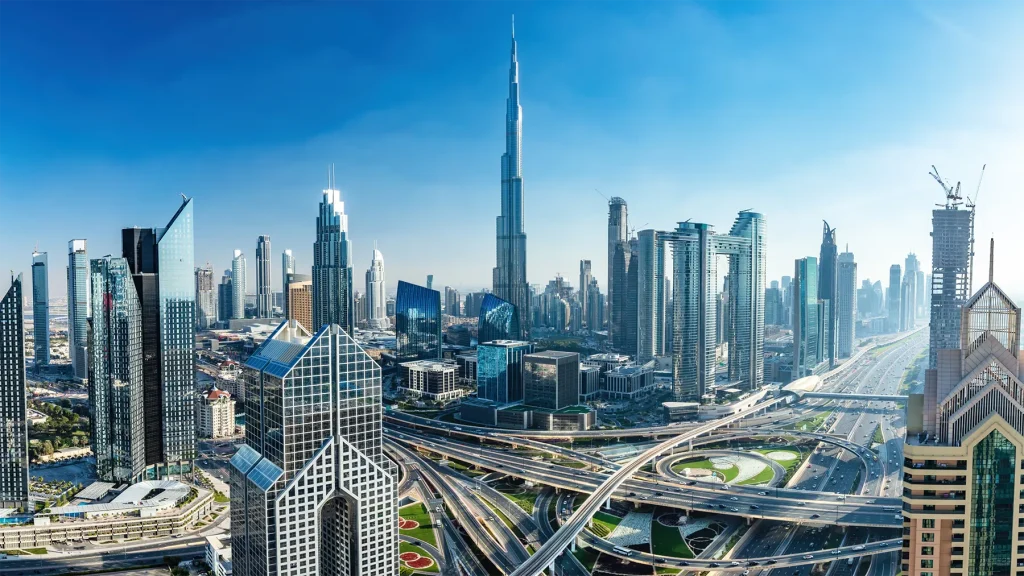
Apartments in affordable Dubai communities still offer the highest gross yields in 2026.Photo: © VALORISIMO
In this article · 9 sections
What is rental yield and how is it calculated in Dubai?
Rental yield is the annual rent a property earns, expressed as a percentage of its price. It is the quickest way to compare two investments with different prices.
Gross yield = annual rent ÷ purchase price × 100. A unit bought for AED 1,000,000 and let for AED 65,000 a year (the median price and rent of a JVC apartment over the last 12 months) gives a gross yield of 6.5%.
Net yield = (annual rent − annual costs) ÷ total acquisition cost × 100. Costs include service charges, maintenance, letting and management fees, insurance and vacancy; acquisition cost adds the DLD transfer fee and agency fees to the price. Net yield is what you actually earn.
Why published yields differ
DXBinteract calculates yield only on units that were both sold and rented in the period, so its figures (8% in JVC) can be higher than a simple median rent ÷ median price (6.5%), which mixes new launches with older rented stock. Property Monitor uses its own valuation-based method. Always compare yields from the same source and period.
What rental yield do apartments, townhouses and villas earn in Dubai?
Apartments yield the most, villas the least. Smaller, cheaper units earn more rent per dirham invested, while villas trade a lower yield for scarcity and long-staying family tenants.
| Property type | Average gross yield |
|---|---|
| All residential | 6.34% |
| Apartments | 6.66% |
| Townhouses | 5.06% |
| Villas | 4.45% |
Source: Property Monitor, August 2026, as published by Engel & Völkers Dubai (updated 9 Sep 2026).
| Year | Median annual rent (all homes) | Gross yield |
|---|---|---|
| 2022 | AED 50,000 | 6% |
| 2023 | AED 54,000 | 8% |
| 2024 | AED 57,000 | 7% |
| 2025 | AED 61,000 | 7% |
| 2026 (to date) | AED 64,000 | 7% |
Source: DXBinteract rental market trends for Dubai (city level, all property types), based on DLD and Ejari records, retrieved 10 Nov 2026. Rent rounded to the nearest AED 1,000, yield to the whole percent.
Yields have held because rents caught up with prices
Between 2022 and 2026 the citywide median rent rose from AED 50,000 to AED 64,000, which kept gross yields around 7% even as prices hit records. In 2026 the balance is shifting: prices per sq ft have eased about 3% year on year, but rents on new leases are now falling faster in some segments.
Which Dubai areas have the highest rental yields in 2026?
The highest yields are in affordable, well-connected apartment communities. Prime waterfront areas yield less, because prices are high relative to rents.
| Area | Median apartment price | Median annual rent | Gross yield (DXBinteract) | Gross yield (Property Monitor, Aug 2026) |
|---|---|---|---|---|
| Jumeirah Village Circle | AED 1,000,000 | AED 65,000 | 8% | 6.36% |
| Arjan | AED 910,000 | AED 62,000 | 8% | 6.95% |
| Dubai South | AED 890,000 | AED 63,000 | 8% | 7.21% |
| Jumeirah Lake Towers | AED 1,450,000 | AED 83,000 | 8% | 6.58% |
| Business Bay | AED 2,000,000 | AED 92,000 | 7% | 5.92% |
| Dubai Hills Estate | AED 2,150,000 | AED 112,000 | 7% | 5.82% |
| Dubai Marina | AED 1,885,000 | AED 108,000 | 7% | 5.51% |
| Dubai Creek Harbour | AED 2,650,000 | AED 130,000 | 7% | 5.12% |
| Downtown Dubai | AED 3,000,000 | AED 140,000 | 6% | 5.10% |
| Palm Jumeirah | AED 5,500,000 | AED 185,000 | 6% | 4.58% |
Sources: DXBinteract location statistics (DLD sales and Ejari rents, rolling 12 months), retrieved 10 Nov 2026; Property Monitor community yields, August 2026, via Engel & Völkers.
Both sources rank the areas in roughly the same order, even if levels differ. Property Monitor also lists International City (8.93%), Dubai Sports City (7.76%), Al Furjan (7.08%) and Dubai Silicon Oasis (6.69%) among the high-yield apartment communities. Our ranking of the top rental yield areas in Dubai goes into each one in detail.
Villa communities
On DXBinteract data, villa communities with gross yields around 7% include Dubai Hills Estate, Arabian Ranches 3, Al Furjan and DAMAC Lagoons, against 4% to 5% in Emirates Hills, Palm Jumeirah and Jumeirah Islands. For one community examined in depth, see our analysis of rental yields and ROI in Dubai Marina.
Are Dubai rents still rising in 2026?
Rents on renewals are still rising, but rents on new leases have started to fall, as tens of thousands of new homes are delivered.
| Lease type | Median annual rent | Change year on year |
|---|---|---|
| New apartment lease, Q3 2026 | AED 68,400 | -2.3% |
| Renewed apartment lease, Q3 2026 | AED 60,000 | +3.5% |
| New apartment lease, October 2026 | AED 67,442 | -6.3% |
| Renewed apartment lease, October 2026 | AED 60,000 | +4.9% |
| New villa lease, Q3 2026 | AED 200,000 | -11.1% |
| Renewed villa lease, Q3 2026 | AED 194,145 | +10.3% |
Source: DXBinteract quarterly (Q3 2026) and monthly (October 2026) market reports, based on Ejari rent contracts, retrieved 10 Nov 2026.
What the gap between new and renewed leases means
Renewals catch up slowly with the market because increases for sitting tenants are capped by the RERA rental index. New leases reflect today’s supply and demand. When new-lease rents fall while renewals rise, the market is turning: landlords who need a new tenant must price more keenly than those who keep theirs. About 43,000 homes have been delivered in Dubai in 2026 so far, and DXBinteract counts more than 120,000 units scheduled for 2027.
What affects rental yield in Dubai?
Three things decide your yield: what you pay, what the unit rents for and what it costs to hold.
Location
Tenants pay for commute time. Communities near the metro, Sheikh Zayed Road and the main business hubs let faster and with less vacancy. Areas far from jobs may show high theoretical yields but longer void periods.
Property type and size
Studios and one-bedrooms yield more than large units because rents do not rise in proportion to size. Villas yield less but tenants stay longer and turnover costs are lower.
Service charges and building quality
Service charges vary widely between buildings and can absorb a large share of the rent. A newer building with high charges may net less than an older, cheaper one.
Market timing
Buying after a price correction lifts yield on day one. In 2026 resale apartment prices per sq ft are about flat year on year while developer prices are down 6% (Q3 2026, DLD), so negotiating hard matters more than in 2024 and 2025.
Should you buy off-plan, and how do tax and financing change your yield?
Off-plan can offer a lower entry price and payment plans, but it earns no rent until handover. Tax and financing then decide what you keep.
Off-plan: appeal and risks
Off-plan made up 72% of purchases in Q3 2026 (Cavendish Maxwell). Payment plans spread the cost, and launch prices can be below comparable ready units on a per-unit basis. The risks are delivery delays, an unknown final rent in a market where supply is rising, and resale before handover in a slower market. Read our full guide on whether to buy off-plan in Dubai.
Taxation
Dubai levies no personal income tax on rent and no capital gains tax for individual owners. Buyers pay a one-off DLD transfer fee, and VAT applies to some services and to commercial property. Corporate structures and owners resident elsewhere may owe tax in their home country. Our overview of real estate taxes in the UAE covers the details.
Financing
A mortgage raises your return on cash invested when the rental yield is above the interest rate, and lowers it otherwise. Banks require proof of income, bank statements and a valuation; developers offer payment plans without bank checks. In October 2026, DLD registered 4,604 mortgage transactions worth AED 13.2bn (Haus51 reading of DLD data). See our guide to financing your investment in Dubai.
How can you get the best rental yield in Dubai in 2026?
In a market where new-lease rents are easing, the yield is made when you buy, not when you let.
Start from the achievable rent today, deduct the real costs, then work back to the maximum price that gives you the net yield you need. If the seller will not meet that price, move on: there are more motivated sellers in 2026 than in the past two years.
- Calculate net, not gross. Ask for the building's current service charge per sq ft and include vacancy.
- Use new-lease rents. Renewal rents are rising but new leases fell 6.3% year on year in October 2026.
- Prefer liquid unit types. Studios and one-bedrooms near transport let fastest.
- Watch local supply. Handovers in your building's area compete directly for your tenant.
- Compare sources. DXBinteract and Property Monitor yields differ by method; use one for comparisons.
Watch out
Published yields are gross and averaged. A specific unit can earn far less after service charges, furnishing, agency fees and empty months. With more than 120,000 homes scheduled for 2027, do not assume rents will keep rising.
Frequently asked questions
What is the average rental yield in Dubai in 2026?
Property Monitor puts the average gross yield at 6.34% in August 2026: 6.66% for apartments, 5.06% for townhouses and 4.45% for villas. DXBinteract’s city-level DLD data show a gross yield of about 7% for 2026 to date.
Which area in Dubai has the highest rental yield?
Among large apartment communities, JVC, Arjan, JLT and Dubai South reach about 8% gross on DXBinteract data. Property Monitor ranks International City (8.93%), Dubai Sports City (7.76%) and Dubai South (7.21%) highest in August 2026.
What is a good rental yield in Dubai?
Engel & Völkers describes roughly 6% to 8% gross as a good yield in Dubai, in line with the 6.66% apartment average. Villas average 4.45%. Net yield is lower once service charges and vacancy are deducted, and a very high yield often comes with more vacancy or weaker resale liquidity.
Is rental income taxed in Dubai?
No. Individuals pay no personal income tax on rent and no capital gains tax in Dubai. Buyers pay the DLD transfer fee at purchase, and owners pay service charges. Your home country may still tax foreign rental income, so check your own tax residence rules.
Are rental yields in Dubai falling?
Gross yields are broadly stable at around 7% on DLD data, but pressure is building. New apartment lease rents fell 6.3% year on year in October 2026 while large deliveries continue, so yields on new purchases depend increasingly on negotiating a lower price.
Figures are indicative as of the date shown: check them with official sources before any decision.
- For information only; this is not tax, legal or financial advice.