

Service Charges in Dubai and Abu Dhabi 2026: Rates per Sq Ft by Community
- Published 13 Oct 2025
- Updated 10 November 2026
- 14 min read
- Data verified on 10 Nov 2026
In short
In 2026, service charges in Dubai have a citywide median of AED 15.54 per sq ft per year across 1,614 RERA-approved building budgets. Community medians run from about AED 3 in villa areas such as DAMAC Hills to AED 28.67 in the Burj Khalifa District, with JVC at AED 16.44 and Dubai Marina at AED 16.31. Abu Dhabi has no public index: broker estimates put Yas Island at AED 15–25 and Saadiyat at AED 20–35, and every budget must be approved by ADREC.
DLD Service Charge Index via Continental Club Property, updated 9 Nov 2026 · Homestead Real Estates, 2026 · PropertySeller, 22 Oct 2026 · A&O Shearman, 15 Sep 2026
AED 15.54per sq ft / year
Dubai citywide median service charge, 1,614 RERA-approved budgets
Source: DLD Service Charge Index via Continental Club Property, Nov 2026
AED 28.67per sq ft / year
Highest community median in the index: Burj Khalifa District
Source: DLD Service Charge Index via Continental Club Property, Nov 2026
3 yearsfixed budgets
Dubai owners’ associations may now lock service fees for three years
Source: Dubai Land Department, 10 Dec 2025
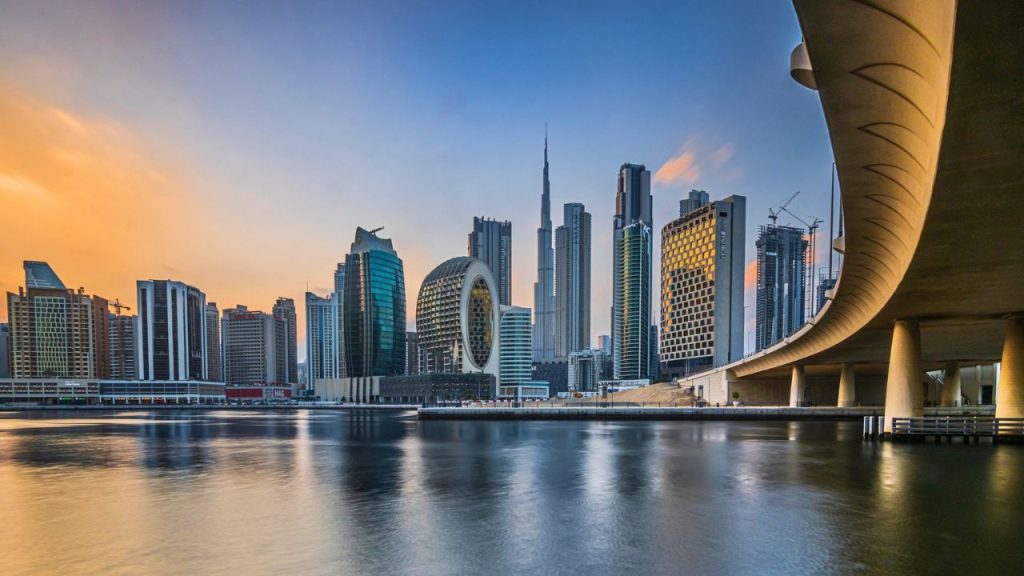
Service charges are billed per square foot and vary widely from one building to the next.Photo: © VALORISIMO
What are service charges and who pays them?
Service charges are the annual fees that every owner in a jointly owned building or community pays to run, insure and maintain the common areas: lobbies, lifts, pools, gyms, security, cleaning, landscaping and the reserve set aside for major works.
They are billed per square foot of the unit, once a year as a budget, and then invoiced in instalments. In Dubai, the budget is prepared by the management company, audited, approved by RERA and published in the Dubai Land Department (DLD) Service Charge Index; invoices are issued through the Mollak system in two to four instalments a year. In Abu Dhabi, the Abu Dhabi Real Estate Centre (ADREC) approves the budget before anything can be invoiced.
Owner, not tenant
The legal debtor is the owner. A vacant unit still pays, and a tenant does not pay the service charge directly: tenants pay their own electricity, water and cooling consumption and, in Dubai, Ejari registration. Landlords recover the cost through the rent they set, which is why service charges weigh directly on net yield.
General fund and reserve fund
Each budget has two parts that are approved separately. The general fund pays for day-to-day running costs; the reserve (sinking) fund builds up money for replacing lifts, chillers, façades or roofs. A building with a very low reserve contribution can look cheap today and face a large special levy later.
What is usually billed separately
District cooling is the main trap. Consumption is always billed separately, and chilled-water capacity charges are often an extra line or billed directly by the cooling provider. Master community fees can also sit on top of the building charge in large developments. Ask for every line before you compare two buildings.
Energy is a large share of the bill. When the DLD last published a breakdown, electricity and central cooling made up 45–65% of total service fees (DLD via MENA Herald, November 2018), which is why newer, more efficient towers can be cheaper to run than older ones with the same amenities.
How much are service charges in Dubai by community in 2026?
Across the DLD index, the citywide median is AED 15.54 per sq ft per year, based on 1,614 RERA-approved budgets. Most mainstream apartment communities sit between AED 12 and AED 20, villa-led communities sit far lower, and prime towers can exceed AED 50.
| Community | Budgets in index | Median (AED/sq ft) | Lowest | Highest |
|---|---|---|---|---|
| Jumeirah Village Circle | 192 | 16.44 | 1.28 | 42.66 |
| Meydan | 107 | 18.90 | 1.07 | 27.37 |
| Dubai Land | 106 | 12.34 | 1.01 | 23.76 |
| Dubai Marina | 104 | 16.31 | 3.52 | 40.20 |
| Business Bay | 84 | 19.97 | 4.94 | 53.95 |
| Dubai Silicon Oasis | 60 | 13.61 | 1.13 | 19.40 |
| Motor City | 58 | 15.72 | 2.02 | 23.25 |
| Dubai Sports City | 52 | 15.75 | 4.41 | 28.29 |
| DAMAC Hills | 48 | 3.13 | 2.11 | 25.61 |
| International City | 44 | 12.66 | 1.95 | 20.98 |
| Al Furjan | 43 | 13.91 | 2.31 | 19.63 |
| Arjan | 38 | 15.67 | 5.58 | 21.97 |
| DMCC (JLT master community) | 37 | 16.42 | 11.14 | 28.09 |
| Dubai South | 37 | 17.13 | 4.04 | 24.50 |
| Downtown Dubai | 28 | 18.98 | 1.43 | 61.36 |
| Dubai Hills Estate | 26 | 18.53 | 2.92 | 29.94 |
| Burj Khalifa District | 25 | 28.67 | 16.40 | 48.47 |
| The Greens | 25 | 14.88 | 6.03 | 23.12 |
| Dubai Creek Harbour | 20 | 20.67 | 1.51 | 35.48 |
| Palm Jumeirah | 17 | 15.65 | 1.56 | 44.82 |
| Jumeirah Village Triangle | 15 | 17.45 | 1.00 | 20.81 |
| Al Barari | 14 | 20.55 | 17.57 | 26.25 |
| Sobha Hartland | 9 | 17.36 | 1.68 | 22.40 |
| Town Square | 8 | 15.42 | 3.34 | 21.91 |
Source: Dubai Land Department Service Charge Index (Mollak), RERA-approved budgets, as compiled by Continental Club Property; table updated 9 November 2026. Median, lowest and highest building budget per community, AED per sq ft per year, all usage types. Selection of 24 of the 40 largest communities by Valorisimo.
How to read the table
The median is the middle building budget in each community, which is more useful than an average because a handful of branded towers would distort it. The “lowest” and “highest” columns show how wide the spread is inside a single community: in Downtown Dubai the cheapest budget is AED 1.43 and the most expensive AED 61.36. Very low figures often belong to villa plots or to budgets filed for a separate usage, so always check the exact project and usage in the index rather than relying on a community figure.
Mid-market communities
The communities that dominate investor demand sit close to the city median. JVC, the largest community in the index with 192 budgets, has a median of AED 16.44; Arjan is at AED 15.67, Motor City at AED 15.72 and Dubai Sports City at AED 15.75. Dubai Land (AED 12.34), International City (AED 12.66) and Dubai Silicon Oasis (AED 13.61) are among the cheapest apartment-led areas. See our Jumeirah Village Circle area guide for prices and rents in the most traded community.
Waterfront and prime areas
Dubai Marina has a median of AED 16.31, but its highest budget reaches AED 40.20. Business Bay sits at AED 19.97 with a top budget of AED 53.95, and Dubai Creek Harbour at AED 20.67. The Burj Khalifa District is the most expensive community median at AED 28.67, with no budget below AED 16.40. Palm Jumeirah has a moderate median of AED 15.65 because villas pull it down, while its towers go up to AED 44.82. Compare these costs with purchase prices in our Downtown Dubai area guide.
Villa communities
Master-planned villa communities have the lowest per-sq-ft charges because owners maintain their own plots: DAMAC Hills has a median of AED 3.13. Remember that villas are larger, so the annual bill in dirhams can still be significant, and gated communities with lagoons or golf courses cost more.
How are service charges regulated in Dubai and how do you check a building?
Dubai has the most transparent system in the region: every approved budget can be looked up by project, usage and year, and charges can only rise through a new budget approved by RERA for the following year.
The legal framework
Jointly owned property is governed by Dubai Law No. 6 of 2019. RERA, the regulatory arm of the Dubai Land Department, reviews and approves each building’s budget, and the Mollak platform handles budgets, invoicing and payment tracking. Owners are entitled to the audited accounts behind the budget, and disputes go first to the owners’ association and then to RERA.
Three-year fixed budgets since December 2025
On 10 December 2025, the DLD and Dubai Holding Community Management approved the first three-year fixed service fee budget, for the Palm Jumeirah Master Community. Management companies of jointly owned properties can now submit a three-year budget through Mollak, while those who prefer the one-year model can keep it. RERA chief executive Abdullah Ahmed Al Shehhi said that all community management companies across Dubai can use the mechanism. For buyers, a fixed three-year budget removes one of the main uncertainties in a net yield forecast.
How to check the approved charge
- Open the Service Charge Index. It is available on the DLD website, in Mollak and in the Dubai REST app; the result is immediate.
- Select the project, the usage and the year. Residential, retail and parking budgets can differ inside the same building.
- Multiply by the unit’s area. The rate applies to the unit’s area as registered, so use the title deed or Oqood figure, not the brochure area.
- Ask for a Mollak statement before signing. Unpaid charges block the resale of a unit until they are cleared, so the seller must settle arrears first.
- Check the trend. Compare the last two or three budget years in the index and ask why any line jumped.
How much are service charges in Abu Dhabi in 2026?
Abu Dhabi does not publish a per-building index. The rate of each building is known from its management company, the developer’s disclosure statement and the invoices, so published figures are broker estimates. The two most recent guides agree on the main islands.
| Community | Homestead, 2026 (AED/sq ft) | PropertySeller, Oct 2026 (AED/sq ft) |
|---|---|---|
| Saadiyat Island | 20–35 | 20–35 |
| Al Reem Island | 16–28 | 16–28 |
| Yas Island | 15–25 | 15–25 |
| Jubail Island | 14–24 | – |
| Al Raha Beach & Al Ghadeer | 12–22 | – |
| Masdar City | 12–20 | 12–16 |
| Hudayriyat Island | 14–20 | – |
| Khalifa City & Zayed City | 10–18 | – |
| Al Reef | 10–16 | – |
Source: Homestead Real Estates, “Service Charges in Abu Dhabi 2026”; PropertySeller, 22 October 2026. Indicative broker estimates, not official rates: ADREC publishes no per-building index. “–” = not covered.
Saadiyat Island is the most expensive community on these estimates, at AED 20–35 per sq ft, reflecting beachfront and branded projects. Al Reem Island (AED 16–28) and Yas Island (AED 15–25) are the core investor markets. Mainland communities such as Khalifa City and Al Reef are cheaper, at roughly AED 10–18. Browse our Saadiyat Island area guide and Al Reem Island area guide to put these costs next to sale prices.
A regulator that has pushed charges down
ADREC has published several years of emirate-wide falls since the fee monitoring system started in 2020. No later emirate-wide figure has been published, so the 2023 result remains the reference point.
| Year | Change in service and community charges | Detail |
|---|---|---|
| 2020 | −18.1% | First year of the DMT fee monitoring system |
| 2021 | −8.3% | Year-on-year |
| 2022 | over −6% | Year-on-year |
| 2023 | −6% | AED 39.7 million saved vs 2022; AED 685 million of jointly owned project budgets approved to end-Q4 2023 |
Source: Abu Dhabi Real Estate Centre (ADREC) via Abu Dhabi Media Office, 24 January 2024 (latest emirate-wide figures published).
Al Reem and Al Maryah: a different jurisdiction
Al Reem Island and Al Maryah Island fall under the real estate jurisdiction of Abu Dhabi Global Market (ADGM), which uses its own AccessRP system rather than the ADREC procedures (East Face Real Estate, August 2026). Check which regulator applies before you rely on the rules described below.
What rules govern service charges in Abu Dhabi?
Abu Dhabi tightened its jointly owned property regime in 2025. Two administrative decisions now set detailed rules on top of Law No. 3 of 2015, and the regulator’s approval is the condition for any charge to be valid.
Administrative Decision No. 25 of 2025: budgets and managers
Before a buyer signs, the developer must hand over a disclosure statement that includes the estimated service fees for the first two fiscal years and a draft management system; the developer is liable for materially inaccurate disclosures for two years from transfer. The management company must be ADREC-accredited, appointed within 30 days of delivering the first unit, use an electronic accounting system and report to ADREC every six months. ADREC approves management systems, annual budgets and service fees, and fees charged without its approval are unlawful and unenforceable. Annual fees are payable monthly or quarterly, and unpaid fees create a lien over the unit that remains enforceable against a new owner (A&O Shearman, 15 September 2026).
Administrative Decision No. 26 of 2025: owners’ committees
An owners’ committee is formed once at least 30% of units are registered to separate owners. It has five to nine resident owners elected on a one-owner-one-vote basis, and developers are excluded even if they still hold unsold units. The committee reviews budgets and monitors the manager; ADREC can dissolve it or remove members.
Collections and resale
Owners have 60 days after the management company’s notice to settle approved charges, according to an ADREC circular of May 2026 reported by East Face Real Estate. Liabilities from the seller’s period of ownership must be settled for the sale NOC. Service charges may also carry 5% VAT where the managing entity is VAT-registrable.
Are service charges higher in Dubai or Abu Dhabi?
On the numbers available, the core investor islands of Abu Dhabi sit in the same band as Dubai’s waterfront areas, while Dubai’s mid-market communities are cheaper than Saadiyat. The bigger difference is transparency: Dubai lets you check any approved budget online, Abu Dhabi relies on the developer’s disclosure.
| Point | Dubai | Abu Dhabi |
|---|---|---|
| Core legislation | Law No. 6 of 2019 on jointly owned property | Law No. 3 of 2015, plus Administrative Decisions No. 25 and No. 26 of 2025 |
| Who approves budgets | RERA (Dubai Land Department) | ADREC; unapproved fees are unenforceable |
| Public per-building lookup | Yes: Service Charge Index (DLD website, Mollak, Dubai REST) | No public index; ask the management company |
| Billing | Through Mollak, usually 2 to 4 instalments a year | Monthly or quarterly, not as one lump sum |
| Multi-year budgets | 3-year fixed budgets allowed since December 2025 | Developer must disclose estimated fees for the first 2 fiscal years |
| Owners’ body | Owners’ association with management company | Owners’ committee of 5 to 9 resident owners, developers excluded |
| Unpaid charges | Block resale until cleared | Lien on the unit, enforceable against new owners |
Source: Dubai Land Department, 10 December 2025 and Service Charge Index page; Continental Club Property, Nov 2026; A&O Shearman, “Abu Dhabi jointly owned property”, 15 September 2026.
A fair comparison therefore uses the actual approved rate of the building you are buying, not a community average. In Dubai you can do this in minutes; in Abu Dhabi, ask the developer for the disclosure statement on an off-plan unit, or the management company for the current budget and the last invoices on a resale.
How much do service charges reduce your rental yield?
Service charges are usually the largest fixed cost of a rented apartment, so a two-point difference per sq ft can move the net yield by a full percentage point.
The calculation is simple: net yield = (annual rent − annual ownership costs) ÷ purchase price. PropertySeller (October 2026) gives a clear Abu Dhabi example: an AED 1,000,000 apartment let at AED 70,000 a year earns a 7% gross yield; with a 900 sq ft unit at AED 20 per sq ft, the AED 18,000 charge brings the yield to 5.2% before maintenance, vacancy, management and insurance.
What a fixed charge takes out of rent
Because the charge is per sq ft and rents differ by area, the same rate weighs far more in cheaper communities. Lucretia International tested a uniform AED 10 per sq ft against Bayut rents for March 2026:
| Community | Average rent (AED/sq ft/yr) | Share of rent taken by AED 10/sq ft |
|---|---|---|
| Al Maryah Island | 138 | 7.2% |
| Saadiyat Island | 117 | 8.5% |
| Yas Island | 112 | 8.9% |
| Al Reem Island | 102 | 9.8% |
| Ghantout | 61 | 16.4% |
| Al Jurf Gardens | 39 | 25.6% |
Source: Lucretia International, Abu Dhabi service charges guide, using Bayut rents for March 2026. AED 10/sq ft is a test value, not a market rate.
A Dubai example
Take a 750 sq ft apartment in a JVC building charged at the community median of AED 16.44: the annual bill is about AED 12,330. In a Burj Khalifa District tower at the median of AED 28.67, the same area costs about AED 21,500. The second unit needs roughly AED 9,200 more rent a year just to stand still. Use our guide to the top rental yield areas in Dubai to compare gross yields, then subtract the approved charge.
What should you check on service charges before you buy?
- The approved rate of the exact building. DLD index in Dubai; disclosure statement or current budget in Abu Dhabi.
- The rate history. Ask for the last three budgets and the reason for any increase.
- The reserve fund. A thin reserve in an ageing tower often means a special levy later.
- Cooling and master community fees. Check whether chiller capacity charges and master fees are billed on top.
- Arrears on the unit. Get a clearance statement: unpaid charges block resale in Dubai and follow the unit in Abu Dhabi.
- Off-plan estimates. On a new launch, treat the estimated fee as a starting point and stress-test your yield with 20–30% more.
Service charges also shape the real cost of buying off-plan, because they start at handover while you may still be paying the developer. Read our UAE property payment plans guide to plan both cash flows together.
Watch out
Community medians hide very wide gaps: in Downtown Dubai, approved budgets range from AED 1.43 to AED 61.36 per sq ft. Never model a yield on an area average. Check the approved rate of the exact building and usage, and confirm whether district cooling is billed on top.
Frequently asked questions
What is the average service charge in Dubai in 2026?
The DLD Service Charge Index gives a citywide median of AED 15.54 per sq ft per year across 1,614 RERA-approved budgets (November 2026). Mainstream apartment communities such as JVC (AED 16.44) and Dubai Marina (AED 16.31) sit close to it; villa communities are far lower.
How do I check the service charge of a building in Dubai?
Use the Service Charge Index on the Dubai Land Department website, in the Mollak system or in the Dubai REST app. Select the project, the usage and the year to see the approved rate, then multiply it by the unit’s registered area.
Who regulates service charges in Abu Dhabi?
The Abu Dhabi Real Estate Centre (ADREC) approves management systems, annual budgets and service fees under Administrative Decision No. 25 of 2025. Fees charged without ADREC approval are unenforceable. Al Reem and Al Maryah Islands fall under ADGM’s real estate jurisdiction.
Does the tenant pay service charges in the UAE?
No. The owner is legally liable for service charges, even when the unit is vacant or let. Tenants pay their own electricity, water and cooling consumption. Landlords recover the cost indirectly through the rent.
Can service charges go up every year?
In Dubai, charges can only change through a new budget approved by RERA, and since December 2025 owners’ associations can lock a three-year fixed budget. In Abu Dhabi, any new or higher fee needs ADREC approval.
Figures are indicative as of the date shown: check them with official sources before any decision.
- For information only; this is not tax, legal or financial advice.
Want the real net yield of a building before you buy?
Read next
Dubai
how 60/40, 80/20 and post-handover plans work, and how to pay at handover.

Dubai
the communities with the highest gross yields, before service charges.
Dubai
price per sq ft by area to set against the annual charge.