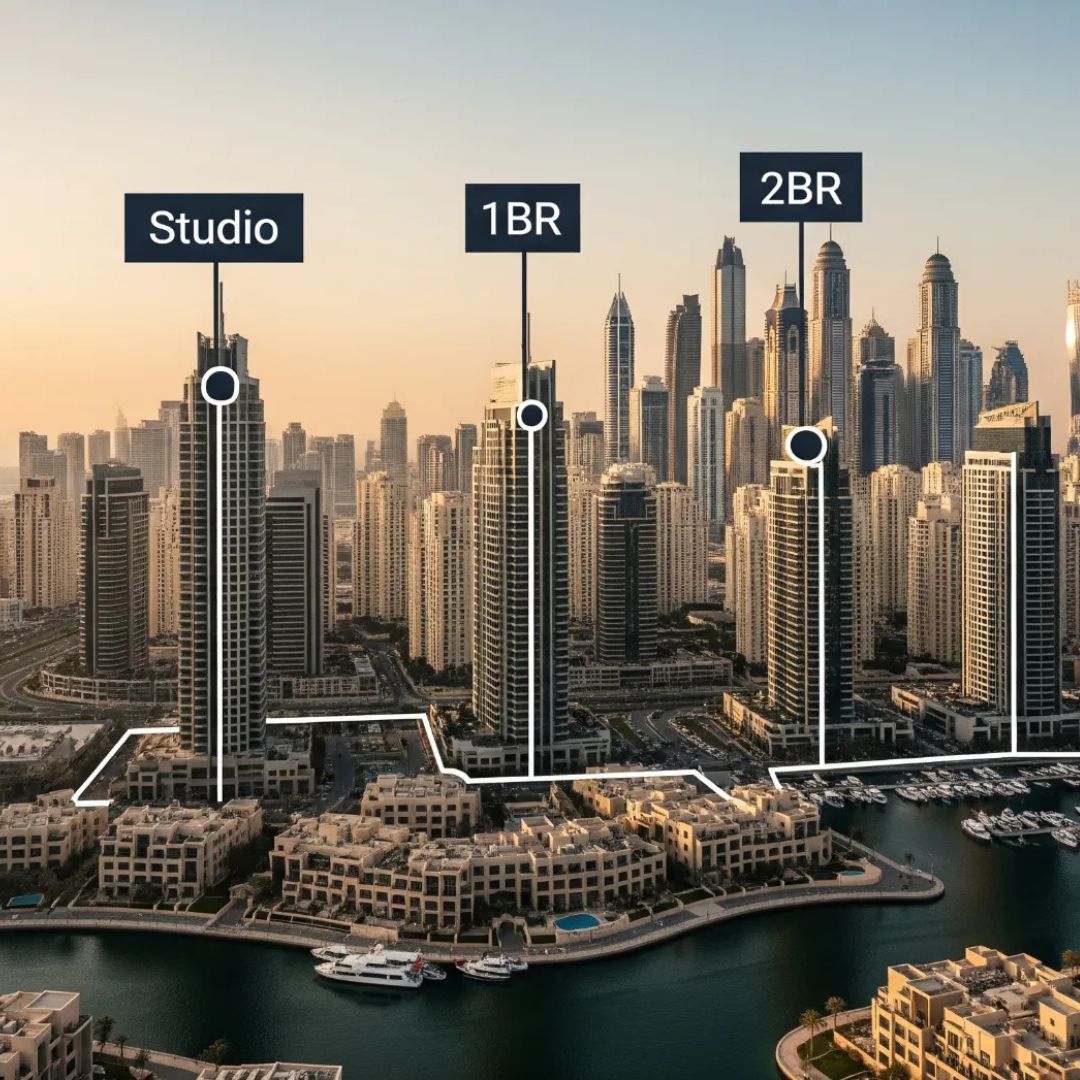
Why Yields Vary Between Studios, 1-BR & 2-BR Units
Investors in Dubai’s property market constantly monitor yields to make informed decisions. Rental yield the annual rental income as a percentage of the property’s value can vary widely depending on unit size, location, and market demand. In this blog, we take a deep dive into why yields differ between studios, 1-bedroom, and 2-bedroom units, and how prime sub-markets like Dubai South, Jumeirah Village Circle (JVC), Al Hebiah Fifth, and Business Bay perform.
Understanding Rental Yield
Rental yield measures how much annual rental income a property generates relative to its purchase price. It is a core metric used by investors to evaluate income efficiency and compare opportunities across different locations and unit types.
Rental Yield Formula
Rental Yield (%) = (Annual Rental Income ÷ Property Purchase Price) × 100
A higher rental yield indicates stronger cash-flow performance, making the property attractive to income-focused investors. A lower yield, on the other hand, often reflects markets or assets where value is driven more by long-term capital appreciation than immediate rental income.
Why Yields Differ Between Unit Types
Rental yields vary significantly by unit type because tenant demand, purchase price dynamics, tenancy duration, and maintenance profiles differ across each segment. From a VALORISIMO data-driven perspective, understanding these structural differences is critical to aligning an investment with the right objective—cash flow vs. capital appreciation.
Key Factors That Influence Rental Yield
- Unit Size: Smaller units typically produce higher percentage yields because acquisition costs are lower while rental demand remains strong.
- Location: Proximity to employment hubs, transport links, retail, and lifestyle amenities directly impacts rental demand and achievable rents.
- Property Quality & Age: Newer or well-maintained properties attract higher-quality tenants and support premium rental pricing.
- Market Dynamics: Local supply–demand balance, new project launches, and population growth all influence rental performance.
Rental yield should never be evaluated in isolation. The strongest investment decisions balance yield potential with risk profile, tenant stability, and long-term value growth rather than focusing on headline percentages alone.
1. Studios
Studios primarily attract young professionals, single tenants, remote workers, and short-term renters. In Abu Dhabi’s mature areas and well-connected waterfront communities, studios benefit from consistent demand driven by affordability and lifestyle convenience.
Yield Range (2024–2025 Data)
- Typical gross yields: 7%–9% in high-demand zones
- In premium but established areas, yields tend to sit at the upper end of the market average, outperforming larger units on a percentage basis
This yield advantage exists because studios have lower entry prices while still commanding competitive rents relative to size.
Operational Considerations
- Faster tenant turnover compared to family units
- Higher wear-and-tear due to shorter tenancy cycles
- More active management required to sustain yield performance
Studios are yield-optimized assets, best suited for investors prioritizing short-term income efficiency and higher cash-on-cash returns rather than long-term capital appreciation.
2. 1-Bedroom Units
1-bedroom units appeal to a broader and more stable tenant base, including couples, dual-income professionals, and long-term expatriates. This segment represents the largest share of rental demand in many Abu Dhabi communities.
Yield Range (2024–2025 Data)
- Typical gross yields: 6%–8%
- Slightly lower than studios due to higher purchase prices, but more consistent over time
While percentage yields may trail studios marginally, 1-bedroom units benefit from longer average tenancy durations, reducing vacancy and turnover costs.
Advantages
- Strong balance between affordability and livability
- Easier resale liquidity due to wider buyer pool
- Better long-term appreciation potential compared to studios
1-bedroom units represent the most balanced investment profile, combining reliable rental income with capital growth potential. They are often favored by investors seeking risk-adjusted returns rather than yield maximization alone.
3. 2-Bedroom Units
2-bedroom apartments primarily attract families, long-term residents, and shared accommodation tenants. These tenants typically stay longer, contributing to rental stability.
Yield Range (2024–2025 Data)
- Typical gross yields: 5%–7%
- Lower percentage yields due to higher capital outlay, even though absolute rents are higher
The higher purchase price dilutes yield percentage, but total annual rental income is often significantly higher in absolute terms.
Advantages
- Longer tenancy periods (often 2–4 years)
- Lower vacancy risk once leased
- Stronger capital appreciation in family-driven communities
2-bedroom units are capital-growth and stability-oriented assets. They suit investors focused on wealth preservation, long-term appreciation, and lower operational intensity rather than maximizing yield percentage.
Comparative Analysis Across Dubai Sub-Markets
Dubai’s residential market is not monolithic. Rental yields, tenant profiles, and risk levels vary materially by sub-market, driven by location, pricing depth, supply pipeline, and end-user demand. Below is an expanded, VALORISIMO-style comparative analysis focused on risk-adjusted yield performance, not headline numbers.
1. Dubai South
Dubai South is an emerging employment-led district anchored by Al Maktoum International Airport, logistics zones, and free-zone business activity. Residential demand here is driven less by lifestyle and more by job proximity and affordability, particularly for aviation, logistics, and industrial professionals.
Yield Trends (2024–2025)
Studios: 7–8%
1-Bedroom: 6.5–7%
2-Bedroom: 5.5–6.5%
Yields remain among the highest in Dubai due to low entry prices rather than elevated rents.
Risk & Stability Factors
Higher sensitivity to employment cycles
Longer leasing times during economic slowdowns
Capital appreciation tied to airport expansion timelines
Dubai South suits yield-first investors with higher risk tolerance. Best for studios and efficient 1-BR units, less suitable for appreciation-focused strategies.

2. Jumeirah Village Circle (JVC)
JVC is one of Dubai’s most active mid-income residential markets, supported by strong infrastructure, retail density, and proximity to business districts. It attracts a broad tenant mix: professionals, couples, and young families.
Yield Trends (2024–2025)
Studios: ~8%
1-Bedroom: 6.5–7%
2-Bedroom: 5.5–6%
Yields remain attractive but are moderating due to rising capital values and increasing supply.
Risk & Stability Factors
Strong absorption but high pipeline risk
Rent growth flattening in oversupplied micro-clusters
Unit quality and building management increasingly impact performance
JVC offers balanced income and liquidity, but asset selection is critical. Newer, well-managed buildings outperform significantly.

3. Al Hebiah Fifth
Al Hebiah Fifth is a family-oriented, affordability-driven sub-market, positioned for long-term residential stability rather than short-term yield optimization.
Yield Trends (2024–2025)
Studios: 6.5–7%
1-Bedroom: ~6%
2-Bedroom: 5–5.5%
Yields are slightly lower than JVC but more stable, with less tenant churn.
Risk & Stability Factors
Slower rent growth
Lower speculative activity
Stronger long-term occupancy
Best suited for long-term hold investors targeting steady occupancy and predictable cash flow, particularly in 2-BR family units.

4. Business Bay
Business Bay is a premium urban core adjacent to Downtown Dubai, dominated by high-rise towers and professional tenants. Demand is driven by proximity to offices, DIFC, and Downtown lifestyle amenities.
Yield Trends (2024–2025)
Studios: 6–6.5%
1-Bedroom: 5.5–6%
2-Bedroom: 5–5.5%
Yields are lower on a percentage basis due to higher capital values, not weak rental demand.
Risk & Stability Factors
Short vacancy cycles
Strong liquidity
Higher service charges impacting net yield
Business Bay is a capital-preservation and appreciation-led market. Ideal for investors prioritizing liquidity, tenant quality, and downside protection over headline yield.

Factors Driving Yield Variation Across Sub-Markets
- Affordability vs. Premium Pricing: Emerging areas like JVC and Dubai South have higher yields due to lower property prices relative to rent, while premium areas like Business Bay have lower yields but potential for capital growth.
- Tenant Demographics: Studio and 1-BR units are favored in communities targeting young professionals, while 2-BR units attract families.
- Supply and Inventory Levels: Oversupply of larger units in some areas reduces yields; limited supply of studios drives higher returns.
- Amenities & Connectivity: Proximity to metro, schools, and retail increases rental potential and stabilizes yields.
Investor Recommendations
- Yield-Focused Investors: Target studios in emerging areas (JVC, Dubai South) for maximum percentage returns.
- Balanced Approach: 1-BR units offer a mix of decent yield and tenant pool diversity.
- Capital Growth Seekers: 2-BR units in premium locations like Business Bay deliver long-term value, albeit with lower initial yields.
- Diversification Strategy: Mixing unit types across sub-markets balances cash flow and appreciation, reducing risk from market fluctuations.
Understanding yield variations between studios, 1-BR, and 2-BR units is crucial for making data-driven investment decisions in Dubai’s dynamic property market. While smaller units generally offer higher yields, location, tenant demand, and unit quality significantly impact returns. Emerging communities like Dubai South and JVC present opportunities for high-yield investments, whereas premium hubs like Business Bay favor investors prioritizing capital growth.
If you’re ready to take the next step, explore our investment opportunities in Dubai and use our investment tool to compare yields and identify properties that match your goals. Have questions about your next real estate investment? Contact VALORISIMO today for personalized guidance and expert advice tailored to your objectives.
Frequently Asked Questions (FAQ)
Why do rental yields differ between studio, 1-BR, and 2-BR units?
Rental yields vary due to differences in purchase price, tenant demand, operating costs, and occupancy rates. Smaller units often have lower entry prices and higher turnover, while larger units offer more stable long-term tenancies.
Which unit type usually delivers the highest rental yield?
Studios and 1-BR units often generate higher gross yields due to stronger demand from singles and short-term tenants, whereas 2-BR units typically provide steadier income with lower vacancy risk.
How should investors choose between studios, 1-BR, and 2-BR units?
Investors should consider budget, target tenant profile, holding period, management intensity, and resale demand. A balanced strategy aligns unit type with market location and investment goals.
Related Posts

Golden Visa Dubai: Complete Guide for Investors in 2025

UAE Mortgage Guide: 2025.

Service Charges in Dubai & Abu Dhabi 2025.

Spotlight on Dubai’s Most Active Developers in 2025

A Comprehensive Guide to Mortgages in Dubai Real Estate

How Cryptocurrency is Shaping the Future of Real Estate in Dubai

Living in Dubai: Expat Guide 2025

Buying Property in Dubai with Cryptocurrency