How to Sell Property in Dubai in 2026: Steps, Seller Fees and Tax on Your Gain
- Published 31 Oct 2026
- Updated 31 October 2026
- 9 min read
- Data verified on 31 Oct 2026
In short
To sell property in Dubai, you obtain the developer’s NOC, then complete the transfer in one appointment at a licensed trustee centre. The Dubai Land Department sets a 2% registration fee for the seller and 2% for the buyer. The UAE levies no personal income tax, but your home country may tax the gain (October 2026).
Dubai Land Department, 29 October 2026 · Federal Tax Authority, October 2024
2%
Seller’s share of the sale registration fee, AED 40,000 on a AED 2,000,000 sale
Source: Dubai Land Department, 29 October 2026
AED 4,200
Trustee (service partner) fee for a sale of AED 500,000 or more: AED 4,000 plus 5% VAT
Source: Dubai Land Department, 29 October 2026
15 to 20minutes
Service time the Dubai Land Department lists for registering the sale of a mortgaged property
Source: Dubai Land Department, 29 October 2026
AED 1,000,000
Annual turnover threshold above which a natural person’s licensed business becomes subject to Corporate Tax
Source: Federal Tax Authority, October 2024
Sell property in Dubai: sale file and keys facing the skyline.Illustration: © VALORISIMO
In this article · 10 sections
- How do you sell property in Dubai, step by step?
- Which documents do you need to sell property in Dubai?
- How much does it cost the seller to sell property in Dubai?
- What happens if the property is still mortgaged?
- Can you sell property in Dubai remotely?
- Is there capital gains tax when you sell property in Dubai?
- What must a tax resident of another country declare?
- Worked example: selling a AED 2,000,000 apartment
- How do you prepare your exit before you buy?
- Frequently asked questions
How do you sell property in Dubai, step by step?
To sell property in Dubai there is no notary: the sale is registered by the Dubai Land Department (DLD) through a licensed Real Estate Trustee centre. The journey is short, but the order of the steps matters. This is the sequence described by the DLD’s official service page (29 October 2026):
- Agree the price and termswith the buyer, and write down who pays which fees (see below).
- Obtain the developer’s NOCIn freehold areas, the developer’s electronic no-objection certificate (e-NOC) is obtained through the Dubai REST app.
- Clear or regularise the mortgage, if there is one (section 4).
- Attend the trustee centrewith the buyer: a registrar checks the file, enters the transaction and has it audited.
- Pay the fees and receive the receiptby email, then enter the buyer’s details with an Emirates ID or passport.
- Receive the electronic title deedin the buyer’s name: the transfer is complete.
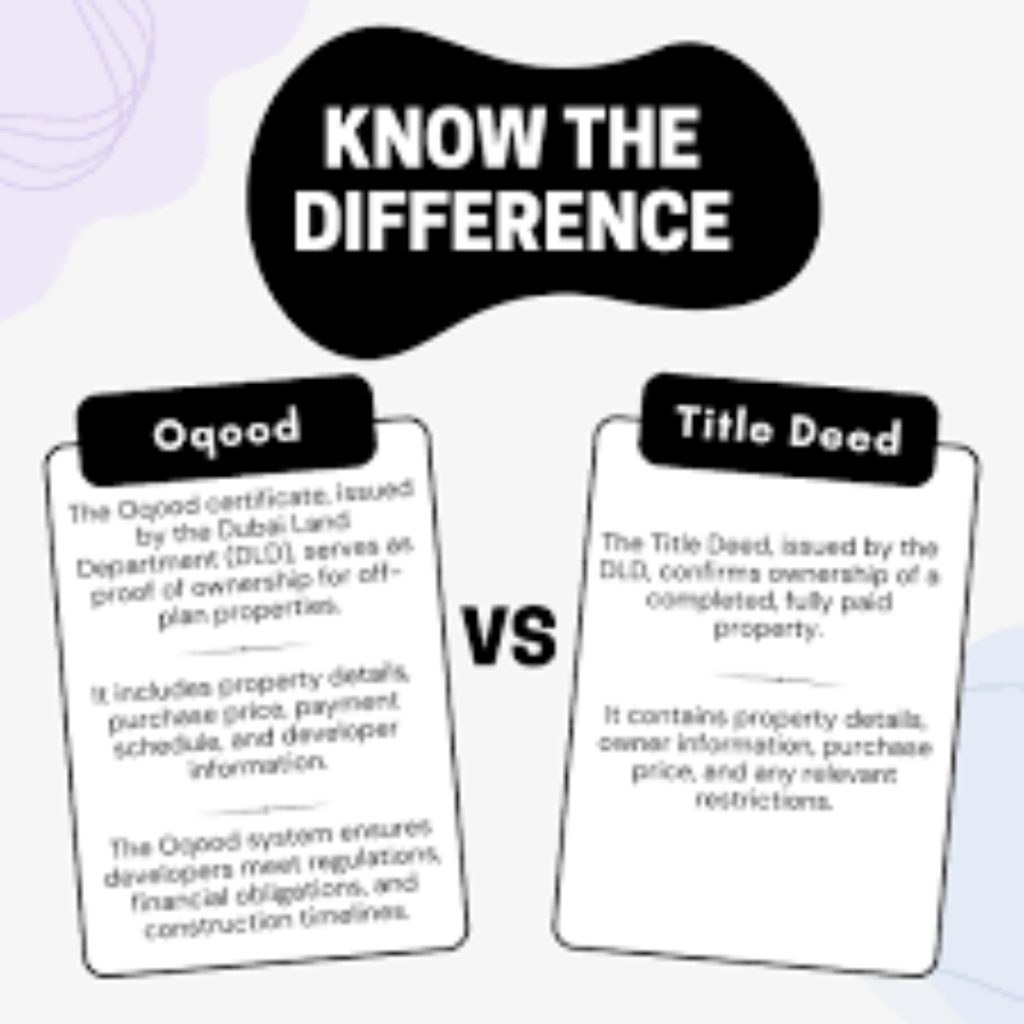
The DLD’s “Sale registration” page lists a service time of 20 minutes. The slow part is therefore not the registration but the preparation: the NOC, the mortgage settlement and the agreement on fees. To understand the documents you will handle, see our explanation of the difference between Oqood and a title deed in Dubai.
Which documents do you need to sell property in Dubai?
According to the DLD’s sale registration page, an individual needs:
- the Emirates ID of both seller and buyer (used only to verify identity, no copy is kept), or a valid passport for a non-resident foreigner;
- the developer's e-NOC for a property in a freehold area, obtained through the Dubai REST app;
- a legal power of attorney if someone acts on behalf of a party (listed on the mortgaged-property service);
- prior company registration if the seller is a company.
For a mortgaged property, the DLD adds a bank letter stating the balance owed and three manager’s cheques (section 4). The item that surprises overseas investors is the power of attorney: if you live abroad, you can give it to a representative rather than fly back to Dubai, provided it is properly drawn up. Our guide to power of attorney in Dubai covers the basics; for a remote sale, have a local legal professional check your document.
How much does it cost the seller to sell property in Dubai?
Official selling costs come in two blocks: the sale registration fee and the trustee’s service fee. This is the schedule on the DLD’s “Sale registration” page (updated 29 October 2026):
| Item | Amount | Who pays? |
|---|---|---|
| Registration fee, seller’s share | 2% of the sale value | Seller |
| Registration fee, buyer’s share | 2% of the sale value | Buyer |
| Service partner (trustee), sale of AED 500,000 or more | AED 4,000 plus VAT (AED 4,200 at 5% VAT) | Not specified |
| Service partner (trustee), sale under AED 500,000 | AED 2,000 plus VAT | Not specified |
| Title deed certificate | AED 250 | Not specified |
| Property map (apartment or villa) | AED 250 | Not specified |
| Knowledge and innovation fees | AED 10 each | Not specified |
Source: Dubai Land Department, “Sale registration application”, page updated 29 October 2026.
Three analyst notes. First, the official page assigns 2% to each party but does not say who pays the trustee, title deed and map fees: that is a clause to negotiate. Second, the sale contract can split the 4% differently from 2% and 2%; our guide to the full cost of buying in Dubai details that split from the buyer’s side. Third, two items have no official schedule: the agent’s commission and the developer’s NOC fee, which each developer sets itself. We publish no unverified figure: ask for both in writing before you list.
What happens if the property is still mortgaged?
A property with a loan outstanding can be sold through a dedicated DLD service, “Registering the Sale of a Mortgaged Property” (29 October 2026). The logic is a sale combined with a repayment: the buyer does not pay everything to the seller.
The DLD requires:
- a bank liability letter stating the remaining balance (or a developer letter for the outstanding amount on an off-plan unit);
- three manager's cheques: one to the bank or developer for the debt, one to the seller for any remaining amount, and one to the DLD for the 4% fee.
The fees specific to this service are listed by the DLD: AED 1,290 for the mortgage release procedure, AED 315 registrar fee for the release, and AED 4,200 registrar fee for a sale of AED 500,000 or more (AED 2,100 below that). The seller then receives a bank indebtedness check to present to the bank to obtain the mortgage release certificate, and registration completes once the release letter is submitted. The DLD lists a service time of 15 to 20 minutes.
Budget separately, outside the DLD schedule, for any early-repayment charge your bank applies. Read your loan agreement before setting a floor price.
What about an off-plan unit still under Oqood?
The same service accepts a developer letter stating the remaining balance to pay. A unit still under Oqood can therefore be resold, but the developer remains a required party. Our article on escrow accounts in Dubai property deals explains where the money sits during construction.
Can you sell property in Dubai remotely?
Partly, through two distinct routes.
Power of attorney. A trusted person can sign for you at the trustee centre with a legal power of attorney. This is the usual route for an owner living abroad.
Dubai Now. The DLD offers a fully digital sale, but its conditions are strict (29 October 2026): the service is for people holding a UAE ID, the property must be free of any mortgage or restriction, located in a freehold area, and be a subdivided unit (apartment, office, townhouse). The price and fees go through a DLD-approved escrow account. A non-resident owner without a UAE ID therefore cannot use it.
In practice, for a non-resident investor, a power of attorney is usually the answer.
Is there capital gains tax when you sell property in Dubai?
For an individual, the official answer is nuanced but reassuring. First, the UAE government portal states that “the UAE does not levy income tax on individuals”. Second, Corporate Tax, in force since June 2023, excludes a natural person’s real estate investment income, meaning the sale, leasing and sub-leasing of UAE property, as long as the activity is not conducted, and does not need to be conducted, through a licence (Federal Tax Authority guide, October 2024).
An individual’s sale of a Dubai apartment is therefore not, in principle, taxed in the UAE. Two limits to keep in mind:
- If reselling becomes a business run under a licence, or one that should have a licence, the regime changes and the AED 1,000,000 annual turnover threshold applies (Federal Tax Authority).
- VAT: residential property supplies are generally exempt, while commercial property is taxed at 5% (Ministry of Finance).
This is not tax advice: confirm your situation with a UAE adviser. For a wider view, read our guide to real estate taxes in the UAE.
What must a tax resident of another country declare?
This is the point most often missed. No tax in Dubai does not mean no tax at all. Many countries tax their residents on worldwide gains. As an example, the French tax administration states that a French tax resident is taxed on all income, including the sale of property abroad.
The 1989 France–UAE tax convention (amended in 1993) provides in Article 11 that gains from selling real estate located in the other State are taxable in that State, so in the UAE. Article 19 then eliminates double taxation on the French side: France may tax the gain of a resident of France, with a credit equal to the tax paid in the UAE, capped at the French tax. As the UAE levies nothing, the credit is nil.
In practice, according to impots.gouv.fr:
- if a convention exempts the gain in France, no filing is needed;
- otherwise, form 2048-IMM must be filed within one month of the sale, and the gain also appears on form 2047 and line 3VZ of the income tax return.
French calculation rules (allowances, rates) depend on your situation and are not quantified here. For the framework, see our page on the France–UAE tax agreement. This is information, not tax advice: consult a tax adviser in your country of residence before you sign.
Worked example: selling a AED 2,000,000 apartment
Take an apartment sold for AED 2,000,000, still mortgaged, in a freehold area. Using the DLD schedule of 29 October 2026, and assuming the seller pays their 2% share, the trustee and the release fees:
| Seller’s item | Amount |
|---|---|
| Registration fee, seller’s share (2%) | AED 40,000 |
| Registrar fee, sale of AED 500,000 or more | AED 4,200 |
| Mortgage release, procedure | AED 1,290 |
| Mortgage release, registrar | AED 315 |
| Total official seller costs | AED 45,805 |
Source: Valorisimo calculation from the Dubai Land Department (29 October 2026). Excludes agent commission, developer NOC fee and any bank early-repayment charge, which have no official schedule.
That is 2.29% of the price. If the buyer takes on the 2% share, the seller’s bill falls to AED 5,805. If the seller pays the full 4%, the registration fee alone reaches AED 80,000. The AED 40,000 gap per 2% is why the sale agreement should state in writing who pays what.
How do you prepare your exit before you buy?
Resale is prepared at purchase. Before you invest, check this list:
- Title or Oqoodconfirm it is in your name and free of restrictions.
- Service charges up to dateask the management company to confirm. See our service charges in Dubai and Abu Dhabi.
- Developer conditionsask in writing for their NOC fee and timeline.
- Your mortgageits exit cost and timetable.
- Your home-country taxkeep purchase and cost records to compute the gain.
- A reliable representativea power of attorney and local advice before you leave.
Watch out
The official Dubai Land Department pages we read do not say who pays the trustee, title deed and map fees, nor the amount of the developer NOC fee or the agent's commission. Each country's tax treatment of your gain depends on your residence and is not quantified here. This is not legal or tax advice: confirm each point before you sign.
Frequently asked questions
*How long does it take to sell property in Dubai?
Registration itself is quick: the Dubai Land Department lists 20 minutes for a sale of a free property and 15 to 20 minutes for a mortgaged one. The real timeline depends on preparation, mainly the developer’s NOC and the bank’s letter. Plan for those two documents before you book the appointment.
*Who pays the transfer fees when you sell in Dubai?
The Dubai Land Department’s schedule splits the registration fee into 2% for the seller and 2% for the buyer, or 4% of the price. The page does not say who pays the trustee, title deed and map fees. The sale contract can set another split, so write it into the agreement.
*Can you sell a mortgaged property in Dubai?
Yes. The Dubai Land Department runs a service for selling a mortgaged property. It requires a bank letter stating the balance owed and three manager’s cheques (bank or developer, seller, DLD). The seller then obtains the release certificate from the bank, which completes the registration.
*Is there capital gains tax on property in Dubai?
For an individual, the UAE levies no income tax and Corporate Tax excludes a natural person’s real estate investment income, unless the activity is run under a licence. A tax resident of another country should still check their home-country filing; in France, that means form 2048-IMM within one month of the sale.
*Can a non-resident sell their Dubai property remotely?
Yes, usually through a power of attorney, with a representative signing at the trustee centre. The digital Dubai Now service requires a UAE ID and a property free of mortgage, which rules it out for most non-residents. Have the power of attorney drawn up by a local legal professional.
Figures are indicative as of the date shown: check them with official sources before any decision.
- For information only; this is not tax, legal or financial advice.
Thinking of selling or buying in Dubai?
Our analysts work through the official fees, the NOC and your home-country tax with you, from official sources, before you sign anything.