
Abu Dhabi Property Market 2026: Trends, Expat Buyers and Investment Insights
- Published 7 Mar 2026
- Updated 10 November 2026
- 11 min read
- Data verified on 10 Nov 2026
In short
The Abu Dhabi property market in 2026 is growing at record pace. ADREC recorded AED 171.26 billion of transactions from January to September, up 76.1%, already above the AED 142 billion of 2025. Expats and overseas investors drove over 70% of residential sales value in H1 2026. ValuStrat measured values up 16.8% in a year, with apartments up 24%. Al Reem, Hudayriyat, Saadiyat and Yas take most of the money.
ADREC, Jan–Sep 2026 and H1 2026 · ValuStrat, Q3 2026 · Bayut, H1 2026
AED 171.26bntransactions
Abu Dhabi real estate deals, Jan–Sep 2026, up 76.1% year on year
Source: ADREC, Jan–Sep 2026
70%+of home sales value
Share of residential sales value from expats and overseas investors
Source: ADREC, H1 2026
+16.8%in a year
Average residential capital values; apartments +24%
Source: ValuStrat, Q3 2026
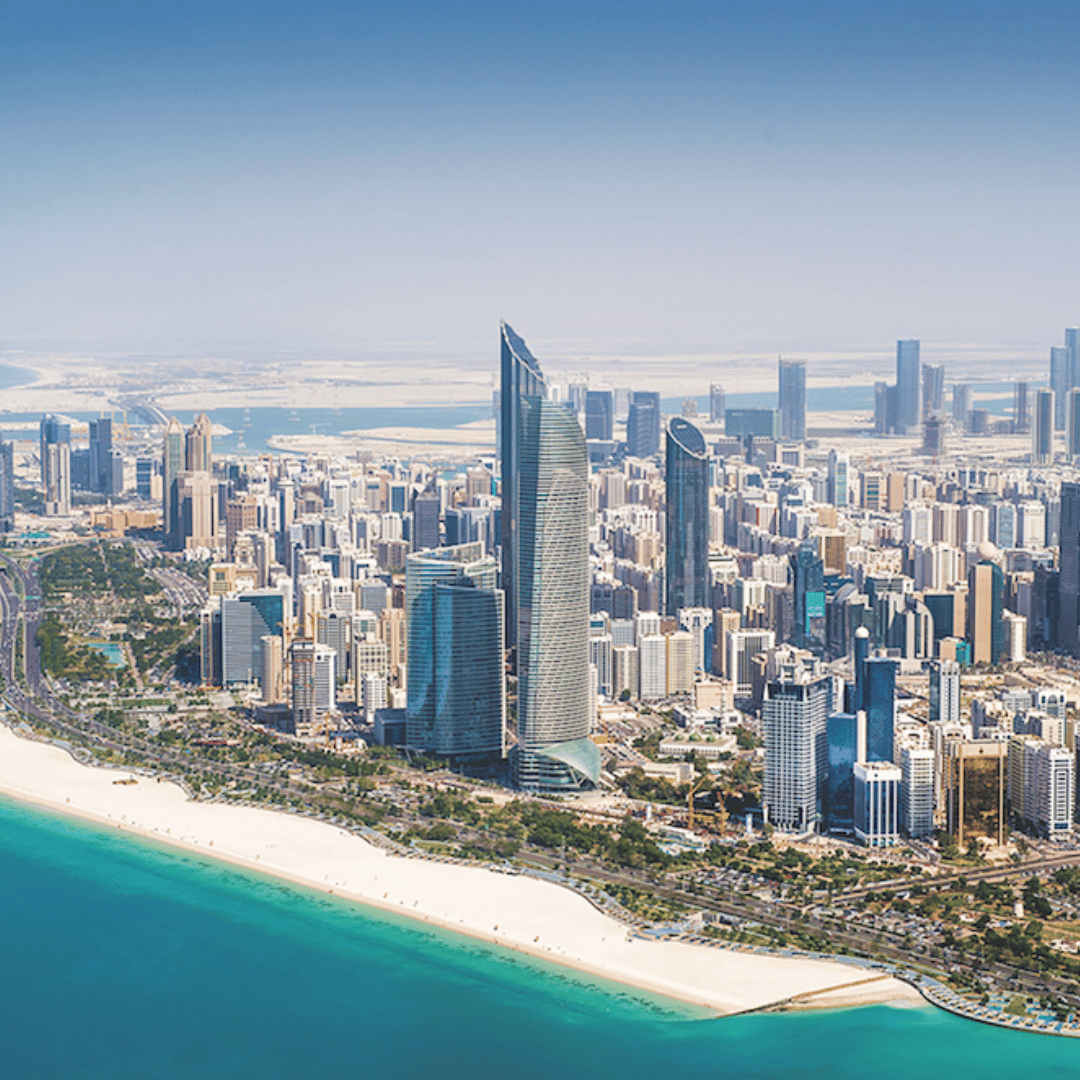
Abu Dhabi: transactions up 76% in the first nine months of 2026.Photo: © VALORISIMO
In this article · 9 sections
How big is the Abu Dhabi property market in 2026?
Nine months into 2026, Abu Dhabi had already gone well past its record full-year 2025 total. Activity is growing on every measure ADREC publishes.
According to the Abu Dhabi Real Estate Centre (ADREC), transactions reached AED 171.26 billion from January to September 2026, up 76.1% on the same period of 2025, across 38,483 deals. Sales accounted for AED 119.33 billion of that. Sales value was 105% higher than a year earlier, and the number of sales rose 49.2%. Mortgages added AED 45.92 billion, up 30.2%.
The comparison with 2025 shows the pace. 2025 was itself a record year: AED 142 billion of transactions, up 44%, and residential sales of AED 76 billion, up 67%. Nine months of 2026 have already gone well beyond it.
| Indicator | Full year 2025 | H1 2026 | Jan–Sep 2026 |
|---|---|---|---|
| Total transaction value | AED 142bn (+44%) | AED 117bn (+112%) | AED 171.26bn (+76.1%) |
| Number of transactions | 42,814 | Not stated | 38,483 |
| Sales value | AED 99.4bn | AED 86.1bn | AED 119.33bn (+105%) |
| Sales transactions | 25,604 | 16,838 | 23,749 |
| Mortgage value | AED 42.7bn | AED 26.7bn | AED 45.92bn (+30.2%) |
| Non-resident FDI | AED 8.2bn | AED 13.8bn | AED 17.22bn |
| Investor nationalities (FDI) | 100+ | 116 | 121 |
Source: Abu Dhabi Real Estate Centre (ADREC) via Abu Dhabi Media Office: full-year 2025 (released Feb 2026), H1 2026 (Jul 2026) and January–September 2026 (7 Nov 2026). Percentages are year-on-year changes as published.
Why 2026 is different
Two things changed. First, sales value grew far faster than mortgage value (+105% against +30.2%), so most of the growth is new purchases rather than refinancing. Second, foreign capital rose sharply. Non-resident direct investment reached AED 17.22 billion in nine months, more than double the full-2025 figure. The development pipeline keeps growing too: ADREC registered 54 new projects in the first nine months of 2026.
Who is buying property in Abu Dhabi in 2026?
Expats and overseas investors now drive the market. They accounted for over 70% of residential sales value in H1 2026.
ADREC data shows that resident expatriates and non-resident foreign buyers together accounted for 62% of residential sales in 2025. In the first half of 2026 their share rose above 70% of residential sales value, which itself almost tripled to AED 70.4 billion. Resident foreign buyers generated nearly 69% of residential sales growth between 2022 and 2025. That points to a lasting shift from renting to owning, not a short-term spike.
Emiratis are buying too: AED 21 billion in H1 2026, against AED 8.9 billion a year earlier. So Abu Dhabi’s boom has broad domestic support and is not driven by foreign capital alone.
| Buyer indicator | Figure | Period |
|---|---|---|
| Resident expats + non-resident foreigners, share of residential sales | 62% | 2025 |
| Same group, share of residential sales value | Over 70% | H1 2026 |
| Emirati buyers, residential sales value | AED 21bn (AED 8.9bn in H1 2025) | H1 2026 |
| Residential sales value, all buyers | AED 70.4bn (AED 25.3bn in H1 2025) | H1 2026 |
| Share of residential growth from resident foreign buyers | Nearly 69% | 2022–2025 |
| Foreign share of investment-zone value | 81% (AED 86.11bn) | Jan–Sep 2026 |
Sources: ADREC via Khaleej Times, 25 Feb 2026 (2025 data) and 18 Aug 2026 (H1 2026 data); ADREC via Abu Dhabi Media Office, Jan–Sep 2026.
Where overseas investors come from
Non-resident investors from 121 nationalities bought Abu Dhabi property between January and September 2026, up from 116 in the first half. By value, the leading sources were the United Kingdom, China, Russia, the United States, France and Germany. Most of this money goes into the emirate’s 50 investment zones, where foreigners can own freehold. Foreign investors accounted for 81% of the AED 86.11 billion invested there in nine months.
Why are more expats choosing to buy rather than rent in Abu Dhabi?
Higher rents, a growing population and longer stays have made owning a home a practical choice for many residents.
Rents have risen, and most homes are rented
ADREC’s 2025 market report found that rents on new apartment leases rose 16% between 2024 and 2025. It also found that 71% of occupied homes in the emirate are rented. In Q3 2026, average apartment rents stood at AED 121,500 a year, up 1.5%, and villa rents at AED 258,000, up 1.8% (ValuStrat). Bayut’s H1 2026 asking rents put a two-bedroom flat on Al Reem Island at about AED 128,000 a year, and a four-bedroom villa on Yas Island at about AED 351,000.
The 0% rent cap
Since June 2026, Abu Dhabi has applied a temporary 0% cap on residential rent increases. Sitting tenants are protected. For a resident who expects to stay several years, though, the bigger question is the rent paid over a whole stay versus the cost of buying. That calculation has pushed many expat families towards ownership.
Population and residency
Abu Dhabi had 4,135,985 residents at the end of 2024, after 7.5% growth that year (Statistics Centre Abu Dhabi). ADREC also notes that occupied units grew 6.6% a year since 2022, against supply growth of 2.8% a year. That gap supports both rents and resale values. Long-term residence options linked to property ownership add a further reason to buy rather than rent. Our guide to living in Abu Dhabi as an expat covers costs, areas and visas in more detail.
How buyers pay
Abu Dhabi remains a largely cash market. 87% of residential sales value in 2025 was registered as cash, and 61% of ready-home purchases in H1 2026 were paid in cash. Mortgage use is growing quickly, however: mortgage value rose 30.2% to AED 45.92 billion in the first nine months of 2026.
Which Abu Dhabi areas attract the most buyers?
Four islands take most of the money: Al Reem, Al Hudayriyat, Al Saadiyat and Yas.
From January to September 2026, Al Reem Island recorded AED 29.86 billion of transactions, the most of any district. It is the emirate’s main ready and rental market for working professionals; see our Al Reem Island area guide. Al Hudayriyat Island followed with AED 28.62 billion. Hudayriyat was the single largest district for residential sales in H1 2026, at AED 19 billion, or 27% of the total. Almost all of it is off-plan; read our Hudayriyat Island area guide before committing to a launch there.
| District | Transaction value, Jan–Sep 2026 | Residential sales value, H1 2026 |
|---|---|---|
| Al Reem Island | AED 29.86bn | AED 10.5bn (with Al Maryah Island) |
| Al Hudayriyat Island | AED 28.62bn | AED 19bn (27% of the total) |
| Al Saadiyat Island | AED 18.69bn | AED 13.3bn |
| Yas Island | AED 13.4bn | AED 7.3bn |
| Zayed City | AED 5.36bn | Not stated |
Sources: ADREC via Abu Dhabi Media Office, Jan–Sep 2026 (all transaction types); ADREC via Khaleej Times, 18 Aug 2026 (residential unit sales, H1 2026).
Saadiyat and Yas
Al Saadiyat Island (AED 18.69 billion) combines prime beachfront villas with the Saadiyat Cultural District. It attracts end-users and buyers who want to hold for the long term. Yas Island (AED 13.4 billion) is the leisure and family hub, with theme parks, golf and schools. Zayed City (AED 5.36 billion) is the main mainland growth corridor.
Off-plan dominates
Off-plan transactions made up 89% of residential sales value and 82% of deals in H1 2026. In 2025, the ten largest developers captured 91% of off-plan primary residential sales value. The choice of developer therefore matters as much as the choice of area. Our ranking of the top Abu Dhabi developers compares them on sales, backlog and delivery.
How fast are Abu Dhabi property prices and rents rising?
Prices are rising much faster than rents. Values gained 16.8% in a year, led by apartments.
ValuStrat’s Q3 2026 review measured average residential capital values up 16.8% year on year. Apartments rose 24% and villas 10.2%. The strongest apartment gains were in Al Reef (+36.6%), Al Bandar (+24.7%), Al Muneera Island (+24.4%) and Al Reem Island (+22%). Over the same period, rents rose by less than 2%. As prices outpace rents, gross yields are gradually compressing.
| Area | Segment | Annual price change, Q3 2026 |
|---|---|---|
| Abu Dhabi, all residential | All | +16.8% |
| Abu Dhabi, apartments | Apartments | +24% |
| Abu Dhabi, villas | Villas | +10.2% |
| Al Reef | Apartments / villas | +36.6% / +26.8% |
| Al Bandar | Apartments | +24.7% |
| Al Muneera Island | Apartments | +24.4% |
| Al Reem Island | Apartments | +22% |
| Saadiyat Island | Villas | +9.9% |
| Hydra Village | Villas | +2.9% |
Source: ValuStrat Abu Dhabi review, Q3 2026, via The National, 29 Oct 2026.
What yields look like now
Bayut’s H1 2026 data still shows healthy gross yields: 8.92% for apartments in Al Reef, 7.63% in Masdar City, 6.34% on Al Reem Island and 5.94% on Yas Island. Waterfront and prime addresses yield less but have so far delivered more capital growth. For prices per square metre, see our Abu Dhabi price per sqm guide.
| Area | Avg asking price (AED/sq ft) | Gross yield | Avg asking rent (AED/year) |
|---|---|---|---|
| Al Reem Island (apartments) | 1,690 | 6.34% | 121,000 |
| Yas Island (apartments) | 2,393 | 5.94% | 141,000 |
| Masdar City (apartments) | 1,781 | 7.63% | Not stated |
| Al Reef (apartments) | 1,065 | 8.92% | Not stated |
| Al Raha Beach (apartments) | 1,859 | 5.72% | 141,000 |
| Yas Island (villas) | 1,634 | 5.00% | 333,000 |
Source: Bayut Abu Dhabi Sales Market Report and Rental Market Report, H1 2026 (advertised asking prices and rents on Bayut.com, gross yields). Asking prices can differ from registered transaction prices.
A note on volumes
Savills recorded 6,085 residential transactions in Q3 2026, 7% fewer than a year earlier, though their value rose 32% to AED 21.5 billion. Fewer, larger deals is typical of a market where prices are climbing and new launches are increasingly premium.
How are culture, jobs and transport projects shaping demand in Abu Dhabi?
Abu Dhabi’s cultural, financial and transport projects are building a long-term case for living in the emirate.
Saadiyat Cultural District
The Zayed National Museum opened in the Saadiyat Cultural District in December 2025, next to Louvre Abu Dhabi. Guggenheim Abu Dhabi is due to open there on 11 December 2026. Landmark museums lift Saadiyat’s profile with international buyers and support premium rents and holiday-home demand on the island.
Jobs and business
New economic licences in Abu Dhabi rose 21% year on year in Q1 2026. Assets under management in Abu Dhabi Global Market (ADGM) rose 54% in H1 2026, and about 50,000 professionals now work there, 34% more than a year earlier (as reported by The National). Finance jobs are a key source of demand for well-located apartments, especially on Al Reem and Al Maryah islands.
Transport
The Etihad Rail passenger service is planned to link Abu Dhabi (Mohamed bin Zayed City) and Dubai (Jumeirah Golf Estates) in about an hour. Mainland communities near the Abu Dhabi station could benefit as commuting between the two cities becomes easier.
What protects foreign buyers in Abu Dhabi?
Abu Dhabi has tightened regulation of brokers, advertising and developers. International benchmarks now rank it as a transparent market.
ADREC issued 3,677 licences to real estate professionals in the first nine months of 2026, 32% more than a year earlier. By mid-2026 the emirate had 3,302 licensed brokers. Its Madhmoun system had facilitated more than 41,200 regulated advertising permits, which helps buyers check that a listing is genuine. Abu Dhabi now has 50 approved investment zones, eight of them added in H1 2026, where foreigners can buy freehold.
In JLL’s 2026 Global Real Estate Transparency Index, Abu Dhabi rose eight places to 33rd and moved from the “Semi-Transparent” to the “Transparent” tier. It ranks second in the Middle East and North Africa.
- Check the zone. Confirm the project sits in an investment zone where your nationality can own freehold.
- Check the developer. Look at delivery history and whether payments go into a project escrow account.
- Check the broker and the ad. Ask for the ADREC licence number and the advertising permit.
- Check real rents. Compare asking rents with recent leases before relying on a yield figure.
What is the outlook for the Abu Dhabi property market?
Supply is limited, so the fundamentals look solid. The main uncertainty is how quickly the off-plan pipeline is delivered.
ValuStrat expects 13,534 new homes to complete in 2026. Only 3,508 had been delivered by the end of September, and 40,510 are scheduled by 2030. ADREC forecasts residential stock growth of about 2.9% a year to 2030, with 43,000 new units in investment zones. Six districts are expected to deliver 77% of new supply: Al Saadiyat, Al Reem, Yas, Zayed City, Khalifa City and Al Hudayriyat. For an expat buyer, this means demand from a growing population should keep meeting relatively tight supply. Price growth, however, is likely to slow from the 2025–2026 pace as large off-plan phases complete. To weigh Abu Dhabi against its neighbour, read our Dubai vs Abu Dhabi comparison.
Watch out
Most activity is off-plan and concentrated in a few islands. Your return depends on the developer delivering on time and on resale demand when several large phases complete together. Check escrow, payment milestones and recent resale prices before you buy.
Frequently asked questions
Is the Abu Dhabi property market still growing in 2026?
Yes. ADREC recorded AED 171.26 billion of transactions from January to September 2026, up 76.1% year on year. Sales more than doubled to AED 119.33 billion. ValuStrat measured residential values up 16.8% in the year to Q3 2026.
Can expats buy property in Abu Dhabi?
Yes, in the emirate’s 50 investment zones, which include Al Reem, Saadiyat, Yas and Hudayriyat islands. Resident expats and overseas buyers together accounted for 62% of residential sales in 2025 and over 70% of residential sales value in H1 2026 (ADREC).
Which areas are most popular with buyers in Abu Dhabi?
By transaction value from January to September 2026: Al Reem Island (AED 29.86bn), Al Hudayriyat Island (AED 28.62bn), Al Saadiyat Island (AED 18.69bn) and Yas Island (AED 13.4bn). Hudayriyat led residential sales in H1 2026 with 27% of the total.
What rental yield can I expect in Abu Dhabi?
Bayut’s H1 2026 data shows gross apartment yields of about 6.34% on Al Reem Island, 5.94% on Yas Island, 7.63% in Masdar City and 8.92% in Al Reef. Net yields are lower after service charges and vacancy. Check actual leases before you buy.
Are rents in Abu Dhabi still rising?
Slowly. ValuStrat recorded apartment rents up 1.5% and villa rents up 1.8% in the year to Q3 2026. Since June 2026, a temporary 0% cap on residential rent increases has also applied, so landlords should not count on rent growth in the short term.
Figures are indicative as of the date shown: check them with official sources before any decision.
- For information only; this is not tax, legal or financial advice.
Thinking of buying in Abu Dhabi?
Read next
Abu Dhabi
prices, yields, fees and areas compared across the two emirates.

Abu Dhabi
the districts posting the strongest price gains this year.
Abu Dhabi
area-by-area picks for yield, growth and family living.