How to Vet a Developer in Abu Dhabi in 2026: 7 Checks Before You Buy Off-Plan
- Published 3 Nov 2026
- Updated 3 November 2026
- 8 min read
- Data verified on 3 Nov 2026
In short
To vet a developer in Abu Dhabi, run seven checks: registration and delivery record, the project’s dedicated escrow account, financial strength, an officially registered contract, the cancellation clause, the payment schedule and the real progress on site. Abu Dhabi’s 2025 rules now give buyers official benchmarks to demand from any developer (November 2026).
ADREC, H1 2026 report · Abu Dhabi Decision No. 24 of 2025 · Decision No. 24 of 2025
89%
Share of Abu Dhabi residential sales value made off-plan in the first half of 2026
Source: ADREC, H1 2026 report
90%
Share of off-plan primary sales captured by the ten leading developers, worth AED 51 billion
Source: ADREC, H1 2026 report
20%
Construction progress required before escrow withdrawals, unless a tightly conditioned exception applies
Source: Abu Dhabi Decision No. 24 of 2025
4years
Minimum registration in Abu Dhabi before a developer can ask for early escrow release
Source: Decision No. 24 of 2025
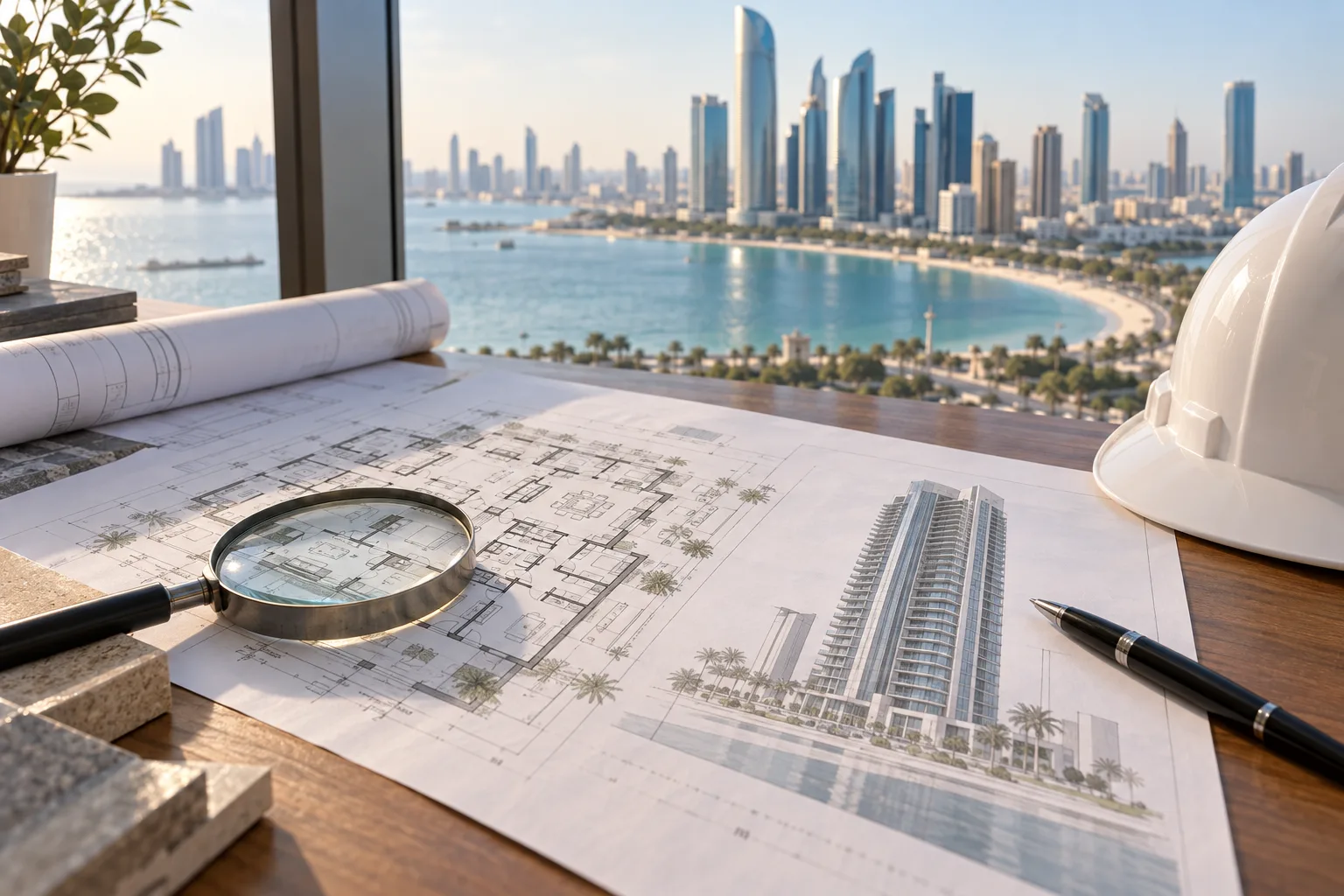
Vet a developer in Abu Dhabi: project plan, magnifying glass and hard hat facing the skyline.Illustration: © VALORISIMO
In this article · 11 sections
- Why should you vet a developer before buying in Abu Dhabi?
- How concentrated is the developer market in 2026?
- Check 1: is the developer registered and has it delivered?
- Check 2: is your money protected by an escrow account?
- Check 3: what does Decision No. 24 of 2025 say about early withdrawals?
- Check 4: is the developer financially solid?
- Check 5: is your contract registered and your expression of interest secured?
- Check 6: what do you get back if you withdraw?
- Check 7: do the payment plan and the site progress match?
- How do you compare two developers in practice?
- Frequently asked questions
Why should you vet a developer before buying in Abu Dhabi?
In Abu Dhabi, buying off-plan is now the norm rather than the exception. According to the first-half 2026 report of the Abu Dhabi Real Estate Centre (ADREC), off-plan sales make up 89% of value and 82% of deals in residential sales, which totalled AED 70.4 billion in six months, almost three times a year earlier (Zawya, citing the ADREC H1 2026 report).
In an off-plan purchase you pay before you own anything. Your safety therefore depends almost entirely on two things: the developer’s ability to deliver, and the regulatory safeguards that protect your instalments. This article does not rank developers: we have already published an Aldar vs Modon comparison and a list of the most active developers in Abu Dhabi. It gives you the method to check any developer, large or small, against official criteria.
A note on method: the rules below come from Abu Dhabi’s 2015 real estate law as amended in 2025 and from administrative decisions issued in 2025. We report them from legal analyses published in 2026. Before you sign, ask ADREC or a local lawyer to confirm the version in force for your project.
How concentrated is the developer market in 2026?
The market is highly concentrated. ADREC reports that the ten leading developers captured 90% of off-plan primary sales, worth AED 51 billion, and that ten projects alone account for 43% of residential unit sales, worth AED 30 billion (Zawya, citing ADREC, H1 2026).
Two Abu Dhabi players have published their first-half or nine-month results:
| Developer | Published sales | Backlog | Period |
|---|---|---|---|
| Modon Holding | AED 26 billion real estate sales, including AED 23 billion in Abu Dhabi | AED 65.4 billion revenue backlog | H1 2026 |
| Aldar | AED 18.9 billion development sales; 78% of UAE sales to overseas and expatriate resident buyers | AED 71.6 billion | 9M 2026, at 30 September |
Source: Modon press release, 29 July 2026; Khaleej Times, 27 October 2026, reporting Aldar’s results.
What should an investor take from this? Size reassures but does not suffice. Modon reports AED 23 billion of sales in Abu Dhabi in the first half, including AED 13 billion within days at the launch of Hudayriyat Golf Estates (Modon, 29 July 2026). Aldar’s development sales fell 34% over nine months versus last year, while it handed over almost 2,000 homes, more than in all of 2025 (Khaleej Times, 27 October 2026). Both profiles are strong, but they tell different stories: one is accelerating launches, the other is converting its backlog into deliveries. That is exactly what your checks should measure.
Check 1: is the developer registered and has it delivered?
First, confirm the developer is registered in Abu Dhabi and has a record of real deliveries, not only launches. The clearest official benchmark is Decision No. 24 of 2025, which sets the conditions for early escrow release: at least four years of registration as a developer in Abu Dhabi and three Abu Dhabi projects delivered on schedule (King & Spalding, 12 May 2026).
You can use those two thresholds as a buying grid even if the developer has not asked for early release:
- How many projects delivered in Abu Dhabi, and how do the dates compare with the announced schedule?
- Since when is it registered in the emirate?
- No recent administrative penalty: the decision requires no violation or penalty in the 12 months before the application.
A newer developer is not a bad developer; it is simply less proven. In that case, lean harder on the protections in the contract and the escrow (checks 2 to 6).
Check 2: is your money protected by an escrow account?
Each off-plan project must have a dedicated escrow account with an approved escrow trustee. Your instalments are paid into it, and the funds cannot pay for the land or for broker commissions: only construction costs, project financing and direct completion costs are permitted (King & Spalding, 12 May 2026).
The baseline rule: no withdrawal until at least 20% of the construction works are complete, as verified by ADREC-approved engineering consultants. That threshold separates a protected off-plan purchase from a simple advance to the developer. For the mechanism in detail, read our guide to off-plan purchases in Abu Dhabi.
Your practical check: ask for the name of the trustee and the project’s account number, and insist that every payment goes there, never to a developer or intermediary account. A payment outside escrow is never a detail.
Check 3: what does Decision No. 24 of 2025 say about early withdrawals?
Since 2025, a developer that meets strict conditions can ask ADREC to withdraw funds before the 20% threshold. It is not automatic: the developer must have been registered for at least four years, have delivered at least three projects on schedule, have had no penalty in the past 12 months, provide an unconditional, irrevocable bank guarantee of at least 20% of total construction cost, and submit an engineering cost report dated within 30 days (A&O Shearman; King & Spalding).
For you, the value is twofold. First, a project with early release is backed by a developer that passed this filter. Second, the bank guarantee is returned only once works reach at least 60% (under conditions) or after full completion, so it protects buyers through the riskiest phase. Simply ask whether the project benefits from it: the answer says a lot about the developer’s maturity.
One honest caveat: the guarantee can tie up funds with the issuing bank, so the developer’s liquidity gain is smaller than it looks, and the measure does not replace your own vigilance.
Check 4: is the developer financially solid?
Listed developers publish accounts; read them. Three lines are enough: cash, debt and backlog.
As an example of how to read them, Modon reports at 30 June 2026 AED 8.6 billion of unrestricted cash and net debt to EBITDA of 0.18 (Modon, 29 July 2026). Aldar reports nine-month net profit of AED 7.1 billion, up 19%, and a development backlog of AED 71.6 billion at 30 September 2026 (Khaleej Times, 27 October 2026).
A large backlog signals demand, not guaranteed delivery: it measures what is still to be built. Compare it with the announced delivery capacity. For an unlisted developer, ask for the latest accounts or, failing that, the project’s bank confirmations. No accounts means no visibility, and that weighs in your decision.
Check 5: is your contract registered and your expression of interest secured?
Since February 2026, every developer launching a new off-plan project must register expressions of interest (EOIs) online on ADREC’s Madhmoun platform. EOI funds are paid into a government-managed escrow account under ADREC oversight, with a digital refund process (Gulf News, 16 February 2026).
Your check: if you are asked for a reservation cheque before a launch, confirm your EOI is registered on Madhmoun and the funds go to the escrow account, not an intermediary. Then make sure your sale contract is officially registered: that registration protects you, and it conditions other steps such as the Golden Visa through property.
Check 6: what do you get back if you withdraw?
Read the cancellation clause before you pay. Under Decision No. 165 of 2025, if the buyer defaults and the unit is cancelled, the developer may deduct from your payments a percentage of the contract value that depends on construction progress:
| Construction progress | Maximum developer deduction |
|---|---|
| Project not started (reasons outside developer’s control) | None: full refund |
| Below 10% | 10% |
| 10% to 30% | 15% |
| 30% to 60% | 25% |
| 60% to 100% | 40% |
Source: Administrative Decision No. 165 of 2025, as analysed by A&O Shearman. If the buyer has already paid 60% or more, ADREC may set the percentage case by case.
The escrow trustee pays the buyer’s balance within 15 business days of the request, and any sum the developer collected outside escrow must be refunded in full within 30 days of ADREC’s cancellation notice (A&O Shearman). This table gives you the real price of changing your mind: the further the works advance, the more an exit costs.
Check 7: do the payment plan and the site progress match?
The last check happens on the ground. Compare the payment plan with real progress: a schedule that makes you pay faster than the site advances should raise a flag. Ask for dated photos, the contractual handover date and what happens if it slips. To compare formulas, see our 2026 payment plans in Dubai and Abu Dhabi.
One more point of care: some contracts are registered several weeks after the reservation. Keep every receipt and insist that each payment is referenced to the project’s escrow account.
How do you compare two developers in practice?
Put the seven checks in a table and score each developer on the same scale. An example grid:
| Check | Question | Evidence to request |
|---|---|---|
| 1 | Registered 4 years, 3 projects delivered? | Project list, completion certificates |
| 2 | Dedicated escrow? | Trustee name, account number |
| 3 | Early release granted? | ADREC confirmation |
| 4 | Accounts published? | Results, debt, cash |
| 5 | EOI and contract registered? | Madhmoun receipt, registered contract |
| 6 | Cancellation clause | The contract’s deduction schedule |
| 7 | Payments tied to progress? | Payment plan, site report |
Our investment comparison tool then helps you compare yields. For market context, read our study of the Abu Dhabi and Dubai markets in the first half of 2026.
Watch out
The 2025 rules are reported from legal analyses published in 2026, not from the official texts themselves; their application may change and each project has its own terms. This article is information, not legal, tax or financial advice: have each point confirmed by ADREC or a local lawyer before you sign.
Frequently asked questions
*How do you check that a developer is registered in Abu Dhabi?
Ask the developer for its registration and the list of projects it has delivered in Abu Dhabi, then have ADREC confirm both. The official 2025 benchmark for early escrow release is four years of registration and three projects delivered on schedule, which is a useful gauge of track record.
*Is my money protected when I buy off-plan in Abu Dhabi?
Each off-plan project must have a dedicated escrow account where your instalments are paid. Withdrawals are blocked until 20% of the works are complete, unless a bank-guaranteed exception applies. Pay only into that account, never to a developer or intermediary account.
*What is Madhmoun for a buyer?
Madhmoun is ADREC’s platform on which developers must, since February 2026, register expressions of interest for a new off-plan project online. The funds go into a government-managed escrow account, with a digital refund if needed. Check that your reservation appears there.
*How much do you lose if you cancel an off-plan purchase?
Under Decision No. 165 of 2025, if the buyer defaults the developer deducts 10% to 40% of the contract value depending on progress: 10% below 10% progress, 15% up to 30%, 25% up to 60%, then 40%. Above 60% already paid, ADREC may decide case by case.
*Should you only choose a large developer?
No. A large developer has a record and published accounts, but size does not replace the checks: escrow, registered contract, cancellation clause and payment schedule. A newer developer can suit you if the contractual and regulatory protections are solid and documented.
Figures are indicative as of the date shown: check them with official sources before any decision.
- For information only; this is not tax, legal or financial advice.
A developer to check before you sign?
Our analysts run the developer and the contract through official sources with you before any payment. WhatsApp: +971 54 236 4178.