

JVC Infrastructure 2026: Current and Future Developments in Jumeirah Village Circle
- Published 17 Jun 2025
- Updated 10 November 2026
- 10 min read
- Data verified on 10 Nov 2026
In short
JVC’s infrastructure is catching up with its growth. The RTA completed the Al Khail Road upgrade in October 2024 and opened Hessa Street phase I in April 2026, cutting that journey from 15 to 4 minutes. Phase II adds a bridge, two ramps and a tunnel straight into JVC, and the Gold Line metro, due on 9 September 2032, names JVC on its route. Meanwhile about 19,500 units are still to hand over in JVC’s DLD area, so supply, not roads, will shape prices in the short term.
RTA via Khaleej Times, Oct 2024 · Dubai Media Office, Feb 2026 · The National, 19 and 22 Apr 2026 · DXBinteract / DLD handover data, 10 Nov 2026
15 → 4 minHessa Street journey
Phase I, Sheikh Zayed Road to Al Khail Road, opened April 2026
Source: RTA via The National, 19 Apr 2026
2032Gold Line opening
42 km underground line with 18 stations; JVC named on the route
Source: The National, 22 Apr 2026
19,518units to hand over
81 projects under construction in Al Barsha South Fourth, to 2031
Source: DXBinteract / DLD, 10 Nov 2026
New bridges and ramps on Hessa Street are designed to ease traffic in and out of JVC.Photo: © VALORISIMO
In this article · 9 sections
Where is JVC and how was it planned?
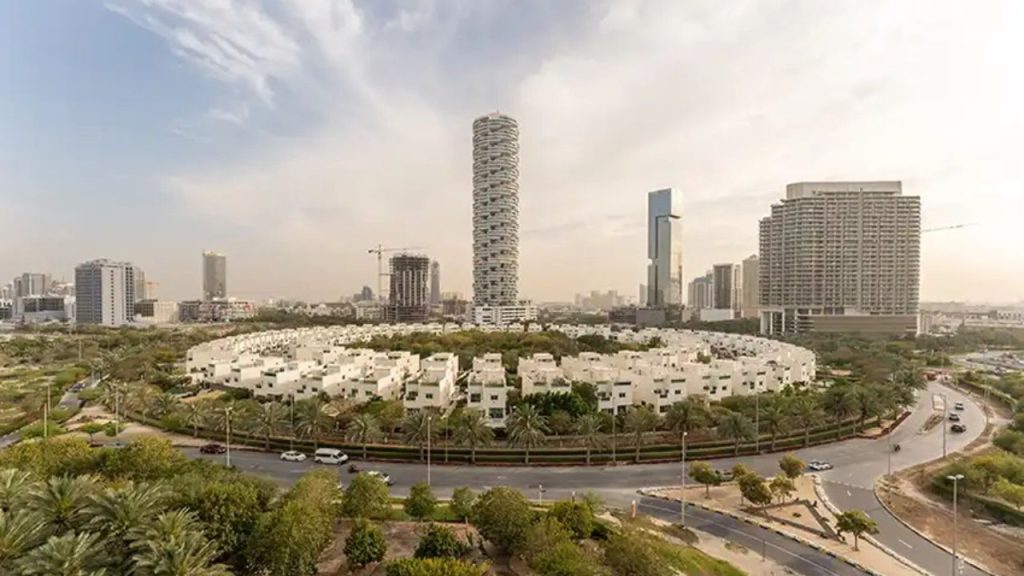
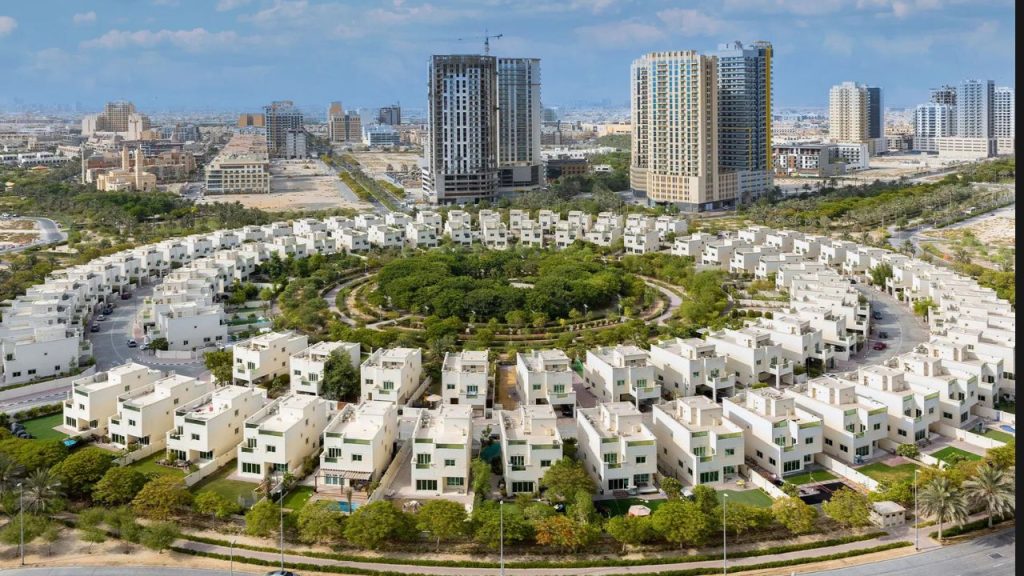
Jumeirah Village Circle is a 560-hectare master community developed by Nakheel, laid out as a ring of districts between three major roads: Al Khail Road (E44), Sheikh Mohammed Bin Zayed Road (E311) and Hessa Street. Its infrastructure story in 2026 is about catching up with very fast growth in the number of people living there.
When the masterplan was drawn, JVC was meant to be a low-density village of villas and townhouses with apartment plots. Two decades later, it has become one of Dubai’s densest mid-market apartment districts. DXBinteract counts about 108,400 registered units in JVC on DLD data, of which about 46,500 are still off-plan, and the area recorded more rental contracts in 2025 than almost any other community in the city.
That growth explains why roads, exits and public transport have become the main issue for residents and the main lever for future value. It also explains the city’s response: two large road projects around JVC were completed between 2024 and 2026, a third is under construction, and the Dubai Metro Gold Line announced in April 2026 names JVC on its route.
JVC also sits inside the logic of the Dubai 2040 Urban Master Plan launched in March 2021, which plans for the emirate’s population to rise from 3.3 million in 2020 to 5.8 million by 2040 and concentrates growth around existing and new urban centres linked by public transport. For the wider picture, see our summary of Dubai’s urban development plans.
Which road projects around JVC are finished in 2026?
Two RTA projects have already changed how traffic leaves JVC: the Al Khail Road development, completed in October 2024, and phase I of the Hessa Street upgrade, opened in April 2026.
Al Khail Road development (completed October 2024)
The Al Khail Road development upgraded seven locations along the corridor, including JVC. As reported by Khaleej Times on completion on 21 October 2024, it delivered five bridges totalling 3,300 metres and 6,820 metres of road widening, raising capacity at the upgraded junctions and bridges to about 19,600 vehicles per hour. In JVC, it added a 700-metre, two-lane bridge between Hessa Street and Al Khamila Street carrying traffic from Al Khail Road towards Hessa Street, with a capacity of 3,200 vehicles per hour, plus 900 metres of surface road works linking JVC traffic to Al Khail Road towards Deira. The RTA expected a 30% cut in travel time along the corridor.
Hessa Street phase I (opened April 2026)
On 19 April 2026 the RTA opened the 4.5 km stretch of Hessa Street between Sheikh Zayed Road and Al Khail Road, widened from two to four lanes in each direction, with four rebuilt intersections at Sheikh Zayed Road, First Al Khail Street, Al Asayel Street and Al Khail Road. The National reported that travel time on the stretch fell from 15 minutes to four and capacity doubled to 16,000 vehicles per hour, benefiting more than 640,000 residents in areas including JVC, Arjan and Al Barsha South.
What infrastructure is planned for JVC next?
The biggest change for JVC drivers is Hessa Street phase II, which brings dedicated bridges, ramps and a tunnel into the community. The biggest change for everyone else is the Gold Line metro, planned for 2032.
| Project | Status | What it changes for JVC | Timing |
|---|---|---|---|
| Al Khail Road development | Completed | 700 m two-lane bridge between Hessa Street and Al Khamila Street (3,200 vehicles/hour) | Opened Oct 2024 |
| Hessa Street phase I | Completed | 4 lanes each way from Sheikh Zayed Road to Al Khail Road; journey cut from 15 to 4 min | Opened Apr 2026 |
| Hessa Street phase II | Contract awarded, under construction | 780 m bridge to Al Khamila Street, 1,050 m ramp to Al Barsha South, 680 m ramp to Hessa Street, 480 m tunnel to Sheikh Mohammed Bin Zayed Road | Awarded Feb 2026; no public completion date |
| Dubai Metro Gold Line | Announced, tender stage | 42 km underground line, 18 stations, JVC named on the route | Stated opening 9 Sep 2032 |
| Etihad Rail passenger station | Under construction | Interchange with the Gold Line at Jumeirah Golf Estates, south of JVC | Not stated in source |
Source: RTA via Khaleej Times (21 Oct 2024) and Dubai Media Office (22 Feb 2026); The National (19 Apr 2026; 22 Apr 2026)
Hessa Street phase II
Awarded on 22 February 2026, phase II covers the 3 km stretch between Al Khail Road and Sheikh Mohammed Bin Zayed Road, where The National put traffic at about 500,000 trips a day. Dubai Media Office lists a 780-metre bridge with three lanes in each direction for entry to and exit from JVC via Al Khamila Street, a 1,050-metre two-lane ramp from JVC towards Al Barsha South, a 680-metre two-lane ramp from JVC to Hessa Street towards Al Khail Road, and a 480-metre two-lane tunnel from JVC towards Sheikh Mohammed Bin Zayed Road. Hessa Street capacity rises from 4,000 to 8,000 vehicles per hour in each direction, and the RTA expects travel time on the corridor to fall from 24 minutes to five. The project serves about 650,000 residents across 10 areas, JVC among them.
Dubai Metro Gold Line
Announced on 22 April 2026, the Gold Line is a AED 34 billion, 42 km line running entirely underground from Al Ghubaiba to Jumeirah Golf Estates, with 18 new stations, interchanges with the Red Line at Business Bay and Jumeirah Golf Estates, and a link to Etihad Rail. The National reported a tender in 2026, a contract award in 2027 and an opening date of 9 September 2032, with up to 465,000 passengers a day after 2040. JVC and Al Barsha South are named on the route map, but a detailed station-by-station list had not been published when we checked, so the exact walking distance from any given building is still unknown.
Our article on how Dubai’s transport projects affect property prices looks at what happened to values around earlier metro lines.
How many new homes will hand over in JVC?
Infrastructure is racing against supply. DLD records show 81 projects with about 19,500 units under construction in Al Barsha South Fourth, the DLD land area that contains JVC, with stated handover dates between now and 2031.
| Stated handover period | Projects | Units |
|---|---|---|
| Delivered 1 Jan – 9 Nov 2026 | 28 | 4,539 |
| 10 Nov 2026 – end 2027 | 42 | 9,338 |
| 2028 | 28 | 6,856 |
| 2029 – 2031 | 11 | 3,324 |
| Total still to hand over | 81 | 19,518 |
Source: DXBinteract analysis of Dubai Land Department (DLD) records, Al Barsha South Fourth, consulted 10 Nov 2026. Dates are developers’ stated completion dates and can slip
DXBinteract’s wider count of JVC’s off-plan pipeline is higher, at 99 projects and about 46,300 units, because it uses a different definition of the community and includes launched units without a confirmed handover date. Either way, the message is the same: JVC will add thousands of homes a year until at least 2028, mostly studios and one-bedrooms.
The largest projects under construction
| Project | Developer | Units | Stated handover |
|---|---|---|---|
| Serenz by Danube, Tower A | Danube | 922 | Dec 2029 |
| Auresta Tower | Tiger | 840 | Dec 2028 |
| Binghatti Circle | Binghatti | 822 | May 2027 |
| One Sky Park | Iman Developers | 590 | Mar 2028 |
| Stax | Pasha One | 530 | Mar 2028 |
| One Park Central | Iman Developers | 526 | Jun 2027 |
Source: DXBinteract analysis of Dubai Land Department (DLD) records, projects under construction in Al Barsha South Fourth, consulted 10 Nov 2026
About 86% of the units in these six projects are studios and one-bedrooms. That is the segment where new supply competes most directly with existing buildings for tenants.
Has infrastructure kept up with demand in JVC?
Demand has grown faster than roads. The number of rental contracts registered in JVC has roughly tripled since 2019, which is why exits onto Al Khail Road and Hessa Street became bottlenecks before the recent upgrades.
| Year | Rental contracts registered | Of which new leases | Sales registered |
|---|---|---|---|
| 2019 | 10,989 | 8,033 | 1,720 |
| 2021 | 16,547 | 11,915 | 3,720 |
| 2023 | 22,811 | 12,314 | 14,295 |
| 2024 | 24,979 | 13,407 | 17,522 |
| 2025 | 33,353 | 20,790 | 18,756 |
| 2026 (to 10 Nov) | 29,012 | 17,460 | 8,877 |
Source: DXBinteract analysis of Dubai Land Department (DLD) records, JVC master community, yearly series consulted 10 Nov 2026
Sales slowed in 2026, with DXBinteract reporting 11,519 transactions over the past 12 months, down 38.8% on the previous 12, while leasing stayed high. That pattern is typical of a community where many units have recently handed over to investors who now rent them out.
Retail, schools and services
Social infrastructure has also grown. Circle Mall opened in April 2021, and Nakheel now lists the Circle Club, parks, sports courts, padel courts, a football pitch and jogging trails among JVC’s facilities. On the DXBinteract school directory, seven private schools rated Good to Outstanding lie within about 3 km straight-line of JSS International School on JVC’s edge. Our guide to living in JVC lists them.
How does infrastructure affect property prices and rents in JVC?
Road upgrades reduce a cost of living in JVC (time lost in traffic), and a metro station is one of the strongest long-term supports for rents in Dubai. But in the short term, the supply pipeline weighs more on prices than any single project.
On DLD data, JVC’s median price for all sales over the past 12 months was AED 1,490 per sq ft, up 2.9% on the previous 12 months, against a Dubai-wide median of AED 1,729. Quarterly, the median eased from AED 1,550 in the fourth quarter of 2025 to AED 1,410 in the third quarter of 2026, while median rents for all units slipped from AED 70,000 in the first quarter of 2026 to AED 65,000 in the third. The detailed figures by unit are in our JVC rental yields and ROI analysis.
Where infrastructure should matter most
Expect the biggest relative benefit for buildings close to the new Hessa Street phase II ramps and tunnel once they open, and, later, for those within walking distance of a confirmed Gold Line station. Buildings deep inside the ring, far from both, benefit less. The metro effect is a 2030s story: with an opening date in 2032, it should not be priced into a purchase today as if it were imminent.
What should buyers check about infrastructure before buying in JVC?
Infrastructure improves the whole community, but individual buildings still win or lose depending on access, parking and what is built next door.
For a full view of prices, payment plans and the comparison with neighbouring communities, read our Jumeirah Village Circle investment guide, and track live figures on the Jumeirah Village Circle area guide.
- Map the exit. Note which ring road and which exit the building uses, and whether it gains from Hessa Street phase II.
- Check neighbouring plots. Use DLD project data to see what is under construction within a few hundred metres and when it is due.
- Do not pay for the metro twice. A Gold Line station is planned for the 2030s; treat any premium for it today with caution.
- Count parking. Denser blocks without enough spaces lose tenants as JVC fills up.
- Follow official sources. RTA and Dubai Media Office announcements are the reference for dates, not marketing brochures.
Watch out
Completion dates for private projects and for phase II of Hessa Street can move. Base a purchase on what exists today and on official announcements, and treat future transport links as upside rather than as the core of the investment case.
Frequently asked questions
Will JVC get a metro station?
The Dubai Metro Gold Line, announced on 22 April 2026, runs from Al Ghubaiba to Jumeirah Golf Estates and names Jumeirah Village Circle on its route, with a stated opening on 9 September 2032. A detailed station list had not been published when we checked, so confirm the exact location with the RTA.
What is the Hessa Street project for JVC?
Phase I, opened in April 2026, widened Hessa Street to four lanes each way between Sheikh Zayed Road and Al Khail Road. Phase II, awarded in February 2026, adds a 780 m bridge, a 1,050 m ramp, a 680 m ramp and a 480 m tunnel connecting JVC to Al Khamila Street, Al Barsha South, Hessa Street and Sheikh Mohammed Bin Zayed Road.
How many new units are being built in JVC?
DLD data via DXBinteract shows 81 projects with 19,518 units under construction in Al Barsha South Fourth, JVC’s land area, with stated handovers to 2031: 9,338 by end-2027, 6,856 in 2028 and 3,324 from 2029. Developers’ dates can slip.
Does new infrastructure raise property prices in JVC?
Better access supports demand over time, but supply matters more in the short run. JVC’s median price was AED 1,490 per sq ft over the past 12 months, up 2.9%, while the quarterly median eased in 2026 as new buildings handed over.
Is traffic still a problem in JVC?
Peak-hour queues at the exits remain the main complaint, especially towards Al Khail Road. Hessa Street phase I has already doubled capacity on that corridor to 16,000 vehicles per hour, and phase II should give JVC its own bridge and tunnel connections once complete.
Figures are indicative as of the date shown: check them with official sources before any decision.
- For information only; this is not tax, legal or financial advice.
Want to know how a specific JVC building is affected?
Read next
Dubai
prices by bedroom, off-plan versus resale and how JVC compares with its neighbours.
Dubai
gross and net yields by unit type, with a worked one-bedroom example.

Dubai
live prices per sq ft, rents and current deals in JVC.