
Emirates Airline History: From 1985 to a Record 2026
- Published 16 June 2025
- Updated 10 November 2026
- 10 min read
- Data verified on 10 Nov 2026
In short
Emirates airline started flying on 25 October 1985 as a small Dubai government venture and is now one of the world’s largest international airlines. In the year to 31 March 2026 it made a record AED 22.8 billion profit before tax, carried 53.2 million passengers and operated 277 aircraft, with 367 more on order. It did so despite the closure of Gulf airspace from 28 February 2026, and it plans to move its hub to Al Maktoum International once that airport is complete.
Emirates Group Annual Report 2025-26 (year to 31 Mar 2026)
AED 22.8 bnprofit before tax
Record result for the year to 31 March 2026, up 7%
Source: Emirates Group Annual Report 2025-26 (year to 31 Mar 2026)
277aircraft in fleet
At 31 March 2026, with 367 more on order
Source: Emirates Group Annual Report 2025-26 (year to 31 Mar 2026)
152destinations
In 80 countries in the 2025-26 network
Source: Emirates Group Annual Report 2025-26 (year to 31 Mar 2026)
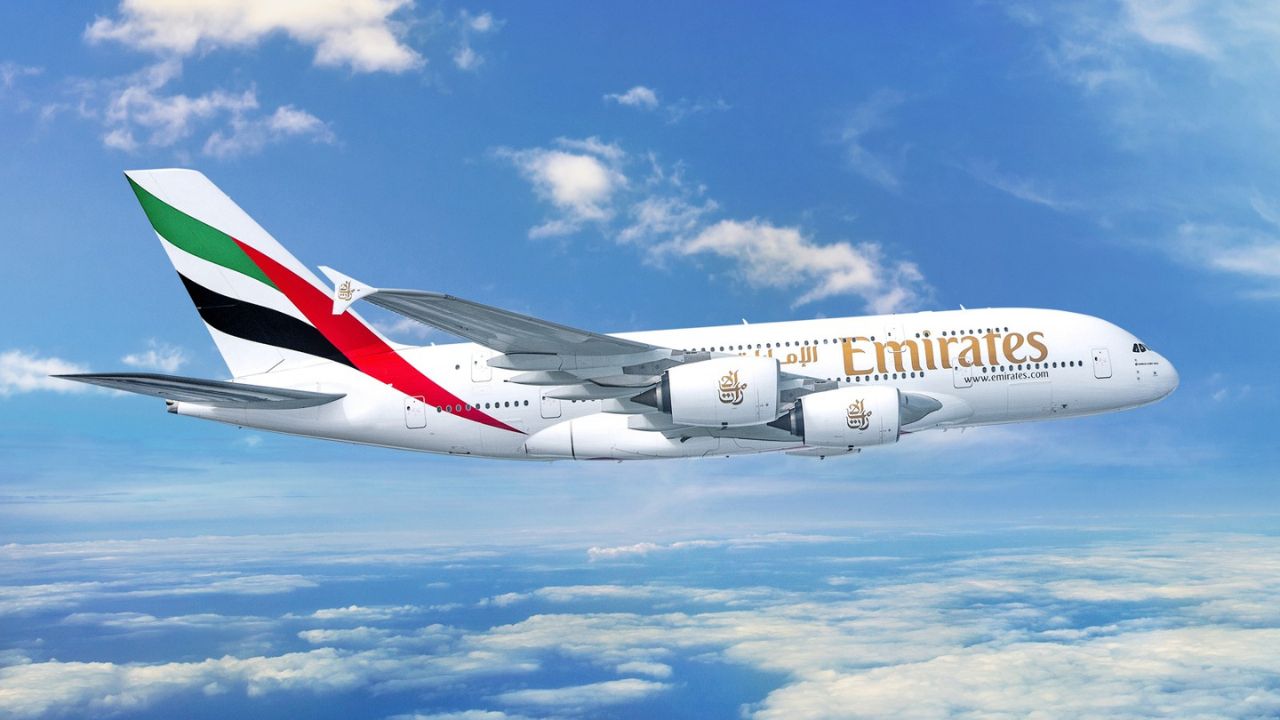
Emirates operated 116 Airbus A380s at 31 March 2026.Photo: © VALORISIMO
In this article · 9 sections
How did Emirates airline start in 1985?
Emirates was created by the Dubai government in 1985 with a deliberately modest start: a small amount of capital, two leased aircraft and a mandate to connect Dubai to the world.
According to the notes to its 2025-26 financial statements, Emirates was incorporated by an Emiri Decree issued by Sheikh Maktoum bin Rashid Al Maktoum on 26 June 1985 and began commercial operations on 25 October 1985. It is wholly owned by the Investment Corporation of Dubai, a Government of Dubai entity, and is designated as the International Airline of the UAE. Sheikh Ahmed bin Saeed Al Maktoum, who led the airline from the start, is today Chairman and Chief Executive of Emirates Airline and Group.
The launch was lean by any standard. Public histories of the airline record US$10 million of start-up capital and two aircraft provided by Pakistan International Airlines. The model that followed has barely changed in four decades: use Dubai’s location, within reach of a large share of the world’s population, to connect long-haul flows between Europe, Asia, Africa, Australasia and the Americas through a single hub.
The hub-and-spoke idea
Instead of flying point to point from a small home market, Emirates built a network in which most passengers change planes in Dubai. That required a very large widebody fleet, a hub airport able to handle waves of connecting flights, and a city that visitors would also want to stop in. Dubai International Airport now holds the position of the world’s busiest airport for international passengers, a point highlighted by Sheikh Mohammed bin Rashid Al Maktoum in the foreword to the 2025-26 annual report.
What are the key milestones in Emirates' history?
Emirates grew in long steps: European slots in the 1990s, an all-widebody fleet, the A380 era, then a decade of records interrupted by two shocks, the pandemic and the 2026 regional conflict.
| Year | Milestone |
|---|---|
| 1985 | Incorporated on 26 June; first commercial flights on 25 October |
| 1991 | Acquires slots at London Heathrow |
| 1996 | First Boeing 777-200 delivered |
| 2000 | Skywards frequent-flyer programme launched |
| 2008 | All operations move to the new Terminal 3 at Dubai International |
| 2021 | Last Airbus A380 delivered on 16 December, closing the programme |
| 2024 | Plan announced to move the hub to Al Maktoum International (DWC) once complete |
| Nov 2025 | Orders 65 more Boeing 777-9s and 8 more A350-900s at the Dubai Airshow (US$41.4 billion at list prices); Starlink Wi-Fi deal |
| Mar 2026 | Record profit year closes despite the regional airspace disruption from 28 February |
Source: Emirates (airline), Wikipedia, accessed Nov 2026, for 1991–2024 · Emirates Group Annual Report 2025-26 (year to 31 Mar 2026) for 1985, 2025 and 2026
Built on widebodies
Emirates chose to fly only large twin-aisle aircraft. It became the world’s largest operator of the Airbus A380 and of the Boeing 777. At 31 March 2026 it still had 116 A380s and 119 Boeing 777-300ERs in service, and its order book is again dominated by long-haul aircraft: 235 Boeing 777-9s, 35 777-8s, 54 more A350-900s and 35 Boeing 787s.
How big is Emirates in 2026?
Emirates reported a record profit for the year to 31 March 2026 and remains, by its own account, the world’s most profitable airline.
The airline’s profit before tax rose 7% to AED 22.8 billion on revenue of AED 130.9 billion, a 17.4% margin. Profit after tax reached AED 19.7 billion, up from AED 19.1 billion a year earlier, helped by lower fuel costs through most of the year. The wider Emirates Group, which includes ground-handling and travel company dnata, made a record AED 24.4 billion before tax on revenue of AED 150.5 billion and closed the year with a record cash balance of AED 59.6 billion. Emirates and dnata announced combined dividends of AED 3.5 billion to their owner.
| Indicator | 2024-25 | 2025-26 |
|---|---|---|
| Revenue and other operating income | AED 127.9 bn | AED 130.9 bn |
| Profit before tax | AED 21.2 bn | AED 22.8 bn |
| Profit after tax | AED 19.1 bn | AED 19.7 bn |
| Passengers carried | 53.7 million | 53.2 million |
| Passenger seat factor | 78.9% | 78.4% |
| Aircraft in fleet | 260 | 277 |
| Employees (Emirates) | 69,465 | 74,980 |
Source: Emirates Group Annual Report 2025-26 (year to 31 Mar 2026), Emirates financial highlights
Passenger numbers dipped slightly because March 2026 was severely disrupted. Excluding that month, the group’s chairman described “month after month” of results above target. The network counted 152 destinations in 80 countries, with four new points added during the year: Da Nang, Siem Reap, Shenzhen and Hangzhou. Through 32 codeshare, 117 interline and 15 multimodal partners, customers can reach more than 1,700 destinations.
Fleet at 31 March 2026
| Aircraft type | In fleet | On order |
|---|---|---|
| Airbus A380-800 | 116 | – |
| Boeing 777-300ER | 119 | – |
| Boeing 777-200LR | 10 | – |
| Boeing 777 freighter | 13 | 8 |
| Airbus A350-900 | 19 | 54 |
| Boeing 777-9 | – | 235 |
| Boeing 777-8 | – | 35 |
| Boeing 787-8 / 787-10 | – | 20 / 15 |
Source: Emirates Group Annual Report 2025-26 (year to 31 Mar 2026), fleet overview
Emirates took delivery of 15 A350s and 5 Boeing 777 freighters during the year, bought out 29 A380s and 5 Boeing 777s at the end of their leases, and raised AED 10 billion in aircraft financing. With 367 aircraft on order and deliveries scheduled until 2038, the airline is planning for decades, not seasons.
How has Emirates handled crises, including the 2026 disruption?
Emirates has been tested by oil shocks, the 2008 financial crisis, the pandemic and, in 2026, the closure of Gulf airspace. Each time the response combined government backing, cargo and fast network recovery.
The most recent test came late in the 2025-26 financial year. On 28 February 2026, military activity “massively disrupted global commercial air traffic in the Gulf region, including in the UAE”, according to the annual report. From 2 March, Emirates and other airlines gradually restarted operations at Dubai’s airports. By 31 March, Emirates was flying 58% of its passenger capacity and had restored connectivity to 122 destinations in 65 countries.
Cargo filled part of the gap. The airline’s 13 Boeing 777 freighters were kept fully busy, 14 passenger aircraft were temporarily reassigned to cargo-only missions, and new trucking and multimodal corridors were opened across the region. Emirates also returned AED 7.7 billion in refunds in March alone and provided hotel stays and meals to stranded customers.
Fuel, the biggest single cost
Jet fuel remained Emirates’ largest cost, at 29% of total operating costs in 2025-26. The fuel bill fell 4% to AED 31.2 billion as average prices dropped 7% to about US$95 a barrel before hedging. Emirates hedged 69% of its Brent crude component that year and says it is “well-hedged until 2028-29”, which softens the impact of the sharp rise in oil prices that followed the conflict.
What sets Emirates' product and strategy apart?
Emirates competes on product as much as on price: large aircraft, a long-haul network and a constant cabin upgrade programme.
- Cabin retrofit. 91 aircraft have been fitted with Premium Economy and refreshed interiors, and the programme continues; 12 A380s and 30 Boeing 777s were retrofitted in 2025-26.
- Connectivity. A November 2025 deal with Starlink brings high-speed Wi-Fi to the fleet; 21 Boeing 777s were already fitted by 31 March 2026.
- Partnerships. New codeshares in 2025-26 included Air Seychelles and Swiss Rail, extending the network by rail as well as air.
- Cargo. Emirates SkyCargo uses passenger belly space plus a dedicated freighter fleet, with 8 more 777 freighters on order.
- Sustainability. Emirates signed an MoU with ENOC Group to explore sustainable aviation fuel supply at Dubai's airports and partnered with DANS and Thales on research to cut arrival holding patterns.
The next hub: Al Maktoum International
The biggest strategic change ahead is the move to Al Maktoum International Airport (DWC) at Dubai South. In April 2024, the Dubai government approved a new passenger terminal worth AED 128 billion, planned for up to 260 million passengers a year with five parallel runways and 400 aircraft gates. Emirates and flydubai are expected to move all operations there once it is complete, and Dubai International is due to close at that point. Full completion is not expected before 2035.
How has Emirates shaped Dubai's economy?
Emirates turned Dubai into a global connecting point, and that connectivity underpins tourism, trade, hotels, offices and residential demand.
The group is one of Dubai’s largest employers, with a record 130,919 employees across Emirates and dnata in 2025-26. Every new long-haul route widens the pool of tourists, business travellers and future residents who can reach Dubai in one flight. Cargo flows through Dubai’s airports feed logistics zones around Jebel Ali and Dubai South. Large events, conferences and exhibitions depend on the same network.
Airline connectivity is one reason Dubai’s population and housing demand have grown so fast over two decades. It is also a risk channel: the March 2026 disruption showed how quickly visitor numbers and short-term rental income can drop when airspace closes, and how quickly they can return once flights resume.
What does Emirates' growth mean for living in or investing in Dubai property?
For property buyers, the aviation story is mostly a location story: the move of the hub to Al Maktoum International shifts long-term demand towards the south of Dubai.
Dubai South, the master community around DWC, is already one of the most active apartment markets in the city on Dubai Land Department data, with entry prices well below the central districts. Downtown Dubai, close to DXB and the business core, sits at the other end of the price scale. The table compares the two with the city-wide median for October 2026.
| Market | Median price per sq ft | Apartment sales | Gross yield |
|---|---|---|---|
| Dubai South (apartments, Jan–Oct 2026) | AED 1,670 | 13,393 | about 8% |
| Downtown Dubai (apartments, Jan–Oct 2026) | AED 2,820 | 1,807 | about 6% |
| All Dubai sales (October 2026) | AED 1,640 | 11,937 (month) | about 7% |
Source: DXBinteract analysis of Dubai Land Department registered sales, Jan–Oct 2026 and Oct 2026
A new airport takes a decade or more to reach full scale, so buyers near DWC should weigh today’s rent, which depends on current jobs in logistics and aviation, rather than the airport’s final capacity. Many projects in Dubai South are off-plan; our guide to buying off-plan in Dubai explains payment plans and the checks to make. For the full picture of the airport, rail and road projects, read Dubai infrastructure in 2026 and its impact on property, and compare central options in our Downtown Dubai area guide. Buyers above the property value threshold may also qualify for long-term residency; see our Golden Visa guide for Dubai property investors.
Watch out
Airport-led price stories are long-term. The March 2026 disruption showed that tourism and short-term rental income in Dubai can fall sharply when airspace closes. Base any purchase near DXB or DWC on current registered prices and rents, not on projected passenger numbers.
Frequently asked questions
When was Emirates airline founded?
Emirates was incorporated by Emiri Decree on 26 June 1985 and started commercial operations on 25 October 1985, according to its 2025-26 annual report. It is wholly owned by the Investment Corporation of Dubai.
Who owns Emirates airline?
Emirates is wholly owned by the Investment Corporation of Dubai, a Government of Dubai entity. In 2025-26, Emirates and dnata announced combined dividends of AED 3.5 billion to their owner.
How many aircraft does Emirates have in 2026?
At 31 March 2026, Emirates had 277 aircraft, including 116 Airbus A380s, 119 Boeing 777-300ERs, 10 777-200LRs, 13 777 freighters and 19 A350-900s, with 367 more on order.
How much profit did Emirates make in 2025-26?
Emirates reported a record profit before tax of AED 22.8 billion on revenue of AED 130.9 billion for the year to 31 March 2026. Profit after tax was AED 19.7 billion. The wider Emirates Group made AED 24.4 billion before tax.
Is Emirates moving to Al Maktoum International Airport?
Yes. Dubai approved an AED 128 billion terminal at Al Maktoum International in April 2024, and Emirates plans to move all operations there once it is complete. Full completion is not expected before 2035, after which Dubai International is due to close.
Figures are indicative as of the date shown: check them with official sources before any decision.
- For information only; this is not tax, legal or financial advice.
Looking at property near Dubai's airports?
Read next
Dubai
what DWC, Etihad Rail and new roads mean for prices.
Dubai
area-by-area price per sq ft for ready and off-plan homes.
Dubai
payment plans, risks and checks before buying off-plan.